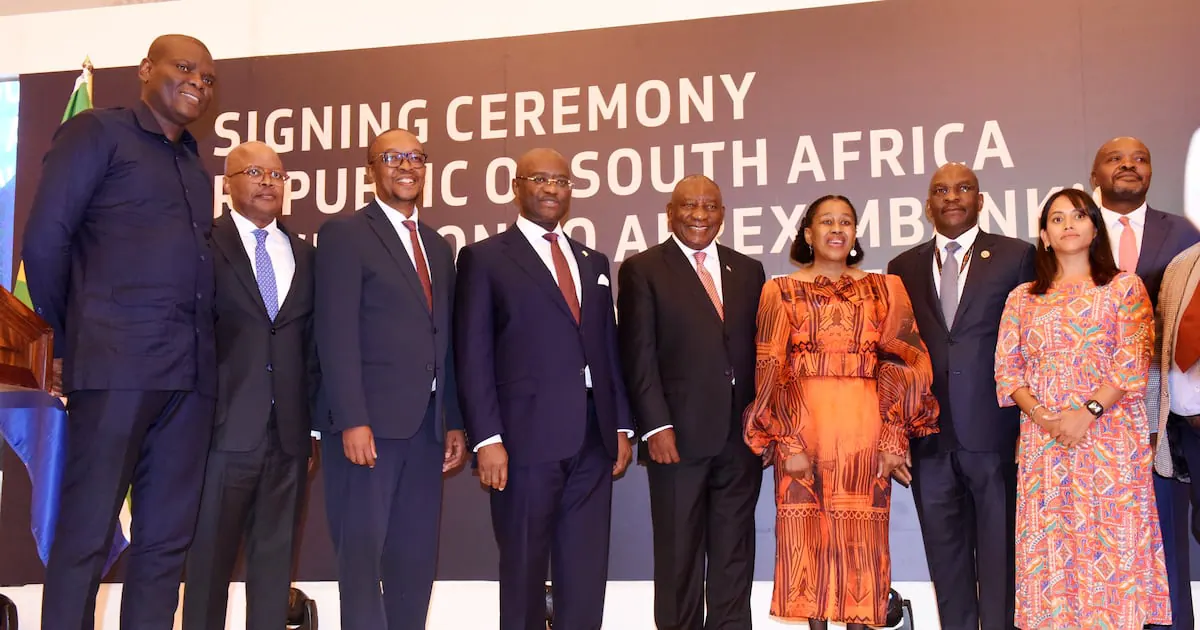
The South African government plans to establish the country's first exclusively dedicated import-export bank within the next five years. This lender, known as SA Eximbank, will have private sector shareholders co-investing alongside the state to strengthen the country's trade competitiveness and unlock R1.3-trillion in export potential. The proposed bank will complement the work of the African Export-Import Bank, a pan-African multilateral lender founded in 1993.
The Export Credit Insurance Corporation of South Africa, which reports to the department of trade, industry and competition, is spearheading the establishment of SA Eximbank. The corporation began a process to appoint transaction advisers who will advise on the structure of SA Eximbank, moving the long-discussed institution closer to implementation. The transaction advisers will review the initial business case for the establishment of SA Eximbank and identify any critical gaps that must be addressed.
The proposed SA Eximbank aims to close the financing gaps that constrain South African exporters and limit their participation in regional value chains. It will also address the financing requirements of small, medium and micro enterprises, black industrialists, new entrants and budding exporters. The bank will provide trade financing instruments to exporters, capacity building and expansion of production, and boost South Africa's industrial and manufacturing bases.
The envisaged capitalisation structure for SA Eximbank will involve leveraging private capital in exchange for a shareholding in the bank. The bank will be funded by a combination of both private and public capital and should retain its policy interventionist and drive government policy and industrial strategy. The SA Eximbank will be funded by both the government and the private sector, including sovereign wealth funds, commercial banks, institutional investors, fund managers, venture capital funds and international export credit agencies and Eximbanks.
The move to establish SA Eximbank comes as South Africa is undergoing fundamental reforms to the logistics sector. The private sector is set to play a more pronounced role in the management of the ports and rail network to boost capacity and the country's competitiveness. The logistics sector has been underperforming, resulting in a significant loss of economic benefit. According to a report by RMB, South Africa has the most untapped export potential of any African country, about R1.3-trillion, or 20% of the country's GDP.
To improve its competitiveness, the government aims to increase Transnet's rail freight volume to 250-million tonnes per year by 2030 through public-private reforms and open network access. Transnet handled 167.9-million tonnes of rail freight in the 2025/26 financial year, up from 160.1-million tonnes the previous year. The Transnet Rail Infrastructure Manager has asked the National Treasury for a further R26bn to refurbish the country's rail network.
The establishment of SA Eximbank and the reforms in the logistics sector are expected to boost South Africa's trade competitiveness and unlock its export potential. The government officially joined Afreximbank as a full sovereign Class A shareholder in April, unlocking access to a $14bn country programme. Several private sector participation projects in the port systems are in the procurement phase, including the Cape Town Multipurpose Terminal, the Richards Bay Dry Bulk Terminal and the Ngqura Manganese Export Terminal.
Key points
- The proposed SA Eximbank will have a capitalisation structure involving both private and public capital.
- The bank aims to unlock R1.3-trillion in export potential and close financing gaps for South African exporters.
- The establishment of SA Eximbank is part of broader reforms in the logistics sector to boost capacity and competitiveness.