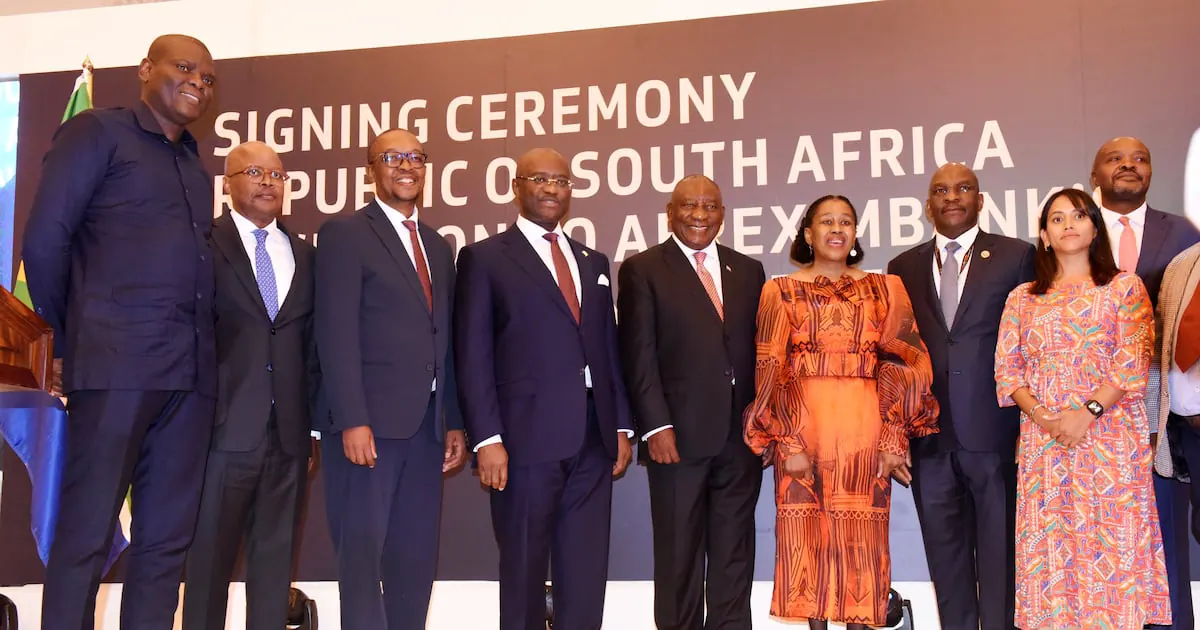
The South African government plans to establish the country's first exclusively dedicated import-export bank within the next five years, with private sector shareholders co-investing alongside the state. The bank, codenamed SA Eximbank, aims to strengthen the country's trade competitiveness and unlock R1.3-trillion in export potential. The Export Credit Insurance Corporation of South Africa (ECIC) is spearheading the establishment of the bank and has begun a process to appoint transaction advisers.
The proposed bank will complement the work of the African Export-Import Bank (Afreximbank), a pan-African multilateral lender founded in 1993. South Africa officially joined Afreximbank as a full sovereign Class A shareholder in April, unlocking access to a $14bn country programme. The ECIC, which reports to the department of trade, industry and competition, aims to close financing gaps that constrain South African exporters and limit their participation in regional value chains.
The SA Eximbank will provide trade financing instruments to exporters, capacity building, and expansion of production to boost South Africa's industrial and manufacturing bases. The bank's capitalisation structure will leverage private capital in exchange for a shareholding in the SA Eximbank, with funding from both the government and the private sector. The transaction advisers will review the initial business case for the establishment of the SA Eximbank and identify critical gaps that must be addressed.
The establishment of SA Eximbank comes as South Africa undergoes fundamental reforms to the logistics sector, with the private sector set to play a more pronounced role in managing ports and rail networks to boost capacity and competitiveness. The logistics sector's underperformance has resulted in significant lost economic benefits, with the country having the most untapped export potential of any African country, according to the RMB's "Where to Invest in Africa" report.
The RMB estimates that South Africa's untapped export potential is about R1.3-trillion, or 20% of the country's GDP, based on supply capacity, demand, and ease of trade. To improve competitiveness, the government aims to increase Transnet's rail freight volume to 250-million tonnes per year by 2030 through public-private reforms and open network access. Transnet handled 167.9-million tonnes of rail freight in the 2025/26 financial year, up from 160.1-million tonnes the previous year.
The Transnet Rail Infrastructure Manager (Trim) has asked the National Treasury for a further R26bn to refurbish the country's rail network, which has not kept pace with evolving logistics needs. However, Trim has concluded agreements with 11 private train operating companies to inject an additional 24-million tonnes of freight capacity across five strategic corridors. Several private sector participation projects in port systems are also in the procurement phase.
The private sector participation projects include the Cape Town Multipurpose Terminal, the Richards Bay Dry Bulk Terminal, and the Ngqura Manganese Export Terminal. The participation of the private sector in the logistics sector is expected to boost capacity and competitiveness, and the establishment of SA Eximbank is seen as a key component of this effort. The bank's ability to provide trade financing instruments and capacity building will be crucial in supporting the growth of South Africa's export sector.
Key points
- The proposed SA Eximbank will have a capitalisation structure that leverages private capital in exchange for a shareholding in the bank.
- The bank aims to unlock R1.3-trillion in export potential and boost South Africa's industrial and manufacturing bases.
- The establishment of SA Eximbank is part of a broader effort to reform the logistics sector and improve South Africa's competitiveness.