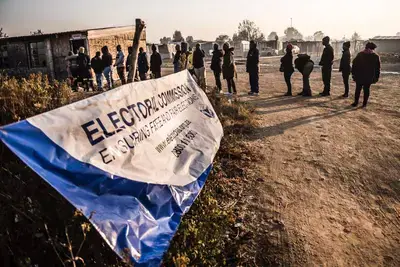
The upcoming local government elections in South Africa are set to take place on November 4, with a record 546 political parties and almost 137,000 candidates competing for just over 10,500 council seats. According to Dr. Oscar van Heerden, a research associate at the University of Johannesburg's Centre for African Diplomacy and Leadership, the staggering number of parties presents a logistical nightmare for the Electoral Commission of South Africa (IEC). Van Heerden believes that new legislation is needed to curb the ease with which political parties can participate in elections.
Independent election analyst Michael Atkins agrees that the number of parties is a nuisance, but suggests that proactive mitigations are possible with careful legislative amendments. Atkins proposes that if ward votes did not count for proportional representation (PR) seat allocations, then ward elections would tend to have only a few candidates and be more meaningful. His comments come as the IEC prepares for the elections, with a focus on ensuring a technically sound process.
Professor Sethulego Matebisi of the University of Free State and head of the Department of Sociology notes that the IEC's readiness is an interesting aspect of this election. While anticipating a technically sound election, Matebisi warns that post-election litigation is a real risk for the IEC. He cites the outstanding MK Party dashboard outage as a concern for the IEC, which has assured voters that systems are in place to avert any vote rigging.
The IEC has taken steps to address concerns around vote rigging, including recruiting about 188,500 electoral officials who have undergone training to ensure efficiency. These officials include presiding officers, deputy presiding officers, area managers, and electoral officers. The IEC has also assured voters that there will be no repeat of the 2024 polls, when the leader board at the national results centre went blank for two hours.
Voters are advised to check their voter details before heading to their voting station, including confirming their voter registration status and finding their voting station. This can be done by SMSing their identity number to 32810 or using the voting station finder on the IEC's website. The IEC is also preparing to accommodate voters who cannot cast their ballots on election day, with 2.6 million special votes approved and over 600,000 home visits scheduled.
The election ballot paper will feature two votes: one for a person to represent the local geographic ward and the second for the party that will be in charge of the municipality. The ward vote can be for someone who represents a party or for an independent candidate. Voters are required to bring a copy of their South African identity document, including a green barcoded ID book or smart ID card, to the voting station.
The demographics of voters who have been approved for special votes and home visits are also being tracked. Women account for 74% of approved special votes, while 80% of approved home visits are for voters older than 60. With the elections just around the corner, the IEC is working to ensure a smooth and efficient process, despite the logistical challenges posed by the large number of parties and candidates.
Key points
- The IEC is facing logistical challenges with 546 political parties and 137,000 candidates vying for 10,500 council seats.
- The IEC has recruited 188,500 electoral officials to ensure efficiency during the elections.
- Voters are advised to check their voter details and bring required documents to the voting station.