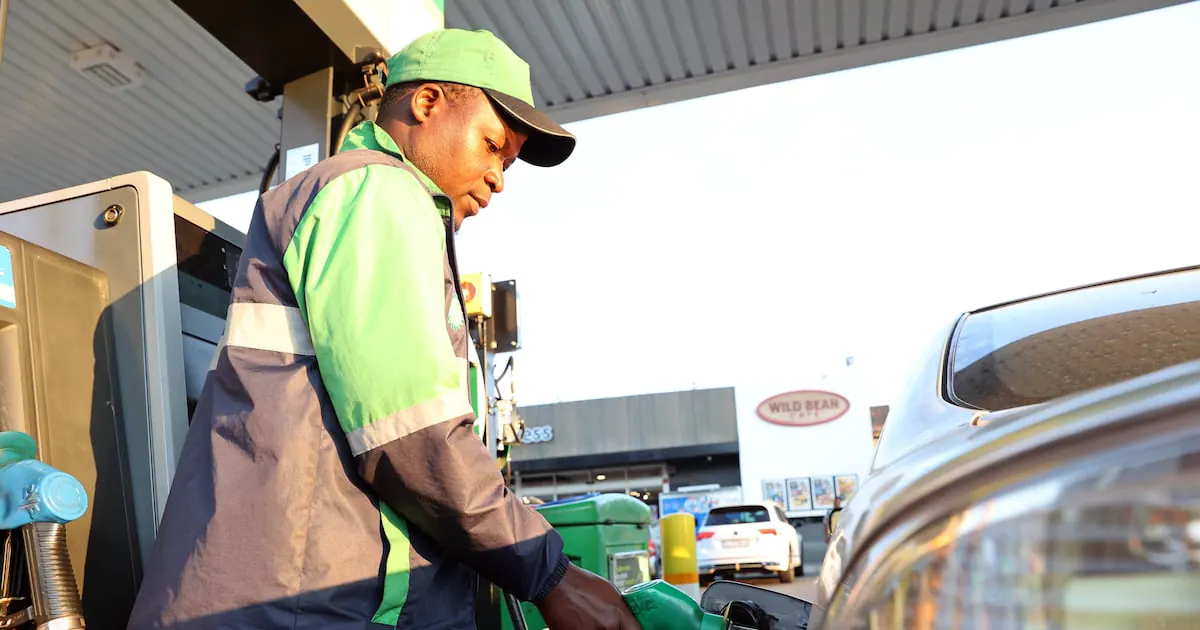
The South African government is expected to announce significant increases in petrol and diesel prices on Monday, effective from Wednesday, due to the ongoing disruptions in global oil supply caused by the US-Iran war. As a net importer of fuel, South Africa is particularly vulnerable to these disruptions, which have kept fuel prices high. The department of mineral and petroleum resources will make the announcement.
In September, the department raised the pump price of 95-grade petrol by R1.34 to R26.92 per litre in Gauteng, while the wholesale cost of diesel climbed by R2.95 and R3.15 for 0.05% sulphur grade and 0.005% sulphur grade, respectively. The latest estimates from the Central Energy Fund suggest that petrol could cost as much as R3.28 more per litre from midnight on Wednesday, while diesel prices are set to soar by as much as R3.19.
The Absa economists, Miyelani Maluleke and Sello Sekele, noted that the government had previously intervened with a temporary reduction in the fuel levy when fuel prices approached these levels. However, it is unclear if this measure will be repeated. The National Treasury has indicated that any further fuel levy relief would need to be done in a fiscally neutral way.
The South African Reserve Bank (SARB) will host its biannual monetary policy forum (MPF) on Tuesday and publish the second edition of its 2026 monetary policy review. This comes after the bank's monetary policy committee (MPC) unanimously decided to hike its benchmark policy rate by 25 basis points to 7.25% due to rising inflation risks stemming from soaring global oil prices.
The SARB's decision to hike interest rates was made despite concerns about the state of the economy, which contracted 0.2% in the second quarter of the year. Governor Lesetja Kganyago acknowledged that the economy was in distress, driven largely by consumer demand. The Absa economists noted that they will be watching for the SARB's assessment of global risks and its analysis of the inflation outlook.
On Thursday, Stats SA will release manufacturing production and sales data for August. The previous report showed that factory output snapped a three-month declining streak in July, edging up 1.1% year on year. However, another recent report indicated that a 1.8% decline in factory output helped push the economy into its second-quarter decline.
Investec economist Lara Hodes expects marginal growth in August of around 0.4% year on year. She noted that advance indications show that September's Absa purchasing managers index moved into positive terrain, with both new sales orders and business activity improving notably, which bodes well for the sector as it moves into the fourth quarter of 2026.
Key points
- The South African government is expected to announce significant increases in petrol and diesel prices on Monday.
- The increases are due to the ongoing disruptions in global oil supply caused by the US-Iran war.
- The South African Reserve Bank will host its biannual monetary policy forum on Tuesday and publish the second edition of its 2026 monetary policy review.