South Africa is home to five Nobel Peace Prize laureates, a testament to the country's commitment to justice, human rights, and democracy. The laureates' work spans decades, from resisting apartheid to promoting democracy, reconciliation, and accountability for human rights abuses. Their contributions have had a lasting impact on the country and the world. The five laureates are Chief Albert Luthuli, Archbishop Desmond Tutu, former president Nelson Mandela, former president FW de Klerk, and international human rights jurist Navi Pillay.
Chief Albert Luthuli was the first South African to receive the Nobel Peace Prize in 1960 for his non-violent struggle against apartheid. As president-general of the African National Congress (ANC), Luthuli advocated peaceful resistance to racial discrimination and apartheid government policies. His award brought international attention to the struggle for equality in South Africa, highlighting the country's repression of those opposing racial segregation. Luthuli's commitment to non-violent resistance made him an influential figure in the liberation movement.
Archbishop Desmond Tutu received the Nobel Peace Prize in 1984 for his role as a unifying leader in the non-violent campaign against apartheid. As an Anglican cleric and outspoken critic of the apartheid government, Tutu drew international attention to racial injustice and called for peaceful political change. He advocated economic and political pressure on the government while insisting on the dignity and equality of all South Africans. Tutu's Nobel Peace Prize acceptance speech highlighted his role as a representative of millions of South Africans who resisted the oppressive system.
Nelson Mandela and FW de Klerk jointly received the Nobel Peace Prize in 1993 for their work towards the peaceful termination of apartheid and laying the foundations of a new democratic South Africa. Mandela, a leading figure in the liberation struggle, spent 27 years in prison before his release in 1990 and subsequent leadership in negotiations to end apartheid. De Klerk, who served as South Africa's last apartheid-era president, announced the unbanning of liberation movements, including the ANC, and oversaw Mandela's release as the country began negotiations towards democratic rule.
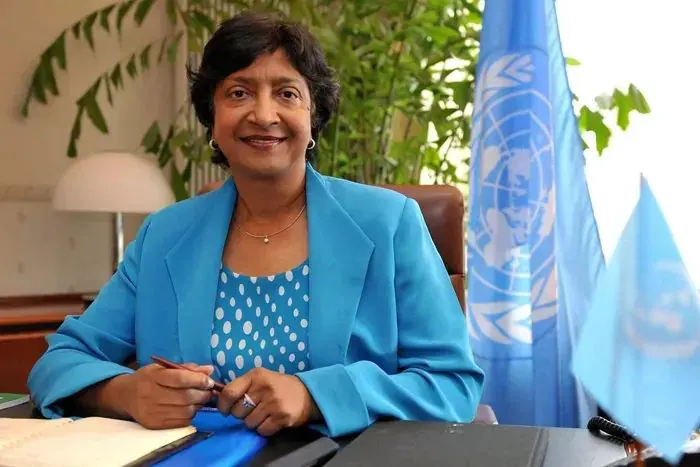
Navi Pillay was awarded the Nobel Peace Prize in 2026 for her efforts to promote peace and international law. The Norwegian Nobel Committee recognised Pillay's longstanding contribution to international justice and the development of a legal system aimed at holding perpetrators of war crimes, crimes against humanity, and genocide accountable. Pillay played a crucial role in the development of international criminal law, including landmark work recognising rape and sexual violence as acts of genocide.
Pillay's distinguished career includes serving as a judge at the International Criminal Court from 2003 to 2008 and as the United Nations High Commissioner for Human Rights from 2008 to 2014. She also chaired the UN Independent International Commission of Inquiry on the Occupied Palestinian Territory, including East Jerusalem, and Israel from 2021 to 2025. Additionally, Pillay served as an ad hoc judge at the International Court of Justice in the case brought by The Gambia against Myanmar under the Genocide Convention.
The legacy of South Africa's Nobel Peace Prize laureates extends beyond the struggle against apartheid, recognising the country's contribution to the advancement of human rights and international law. Their work has had a lasting impact on the country and the world, promoting justice, democracy, and accountability for human rights abuses. The laureates' contributions serve as a testament to South Africa's commitment to upholding human rights and promoting peace.
Key points
- South Africa has five Nobel Peace Prize laureates: Chief Albert Luthuli, Archbishop Desmond Tutu, Nelson Mandela, FW de Klerk, and Navi Pillay.
- The laureates' work spans decades, from resisting apartheid to promoting democracy, reconciliation, and accountability for human rights abuses.
- Navi Pillay was awarded the Nobel Peace Prize in 2026 for her efforts to promote peace and international law.