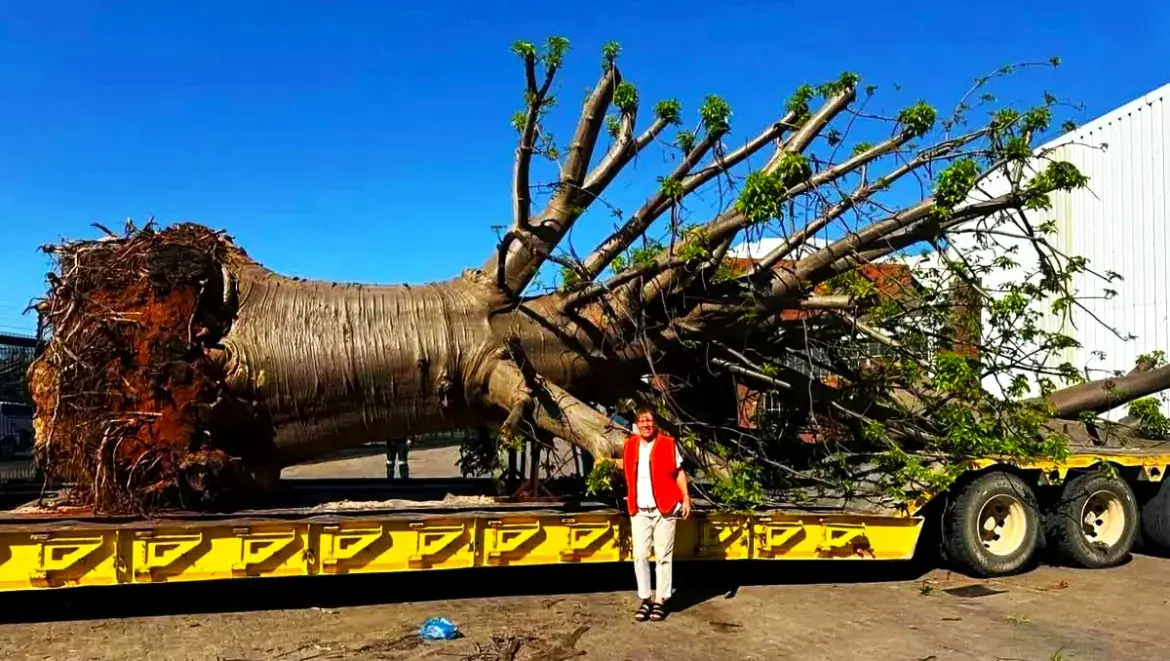
In a significant conservation effort, South African authorities have blocked the shipment of five baobab trees that were being exported to Georgia. The trees, estimated to be around 300 years old and weighing up to 30 tons each, were intercepted on July 17, 2026, at an Africa Global Logistics warehouse in Durban's Mobeni industrial area. They were reportedly awaiting shipment to Georgia when authorities stepped in.
The baobab trees had been removed from the Lephalale area in Limpopo by Divine Landscapes, a company based in Pretoria. However, authorities established that the company did not have the necessary permits to uproot, sell, transport, or export the protected indigenous trees. Despite the company's claims that the trees had been sourced from private gardens with the owners' consent, the Department of Forestry, Fisheries and the Environment (DFFE) rejected its retrospective permit applications.
The trees were left horizontally on hot paving for several months, causing them to become dehydrated and shrink. Despite their condition, all five trees are reportedly still alive. Ecologist Dr. Sarah Venter, founder of the Baobab Foundation, played a crucial role in mobilizing funding to save the trees. Former Durban Botanic Gardens curator Christopher Dalzell also volunteered his expertise to assist with the relocation.
The relocation operation began on November 11, 2026, when the first of the five trees was loaded onto an abnormal-load truck for the approximately 900-kilometer journey to the Timbavati Private Nature Reserve. The trees will undergo a recovery process after spending more than three months in a port warehouse parking area. The DFFE confirmed that it is working with the South African National Biodiversity Institute (SANBI) to facilitate the intervention.
The rescue operation was initiated by Dr. Venter and her team, who helped mobilize funding to save the trees. The DFFE and SANBI are working together to ensure the trees receive the necessary care. The company's argument that the trees had been sourced from private gardens with the owners' consent was rejected by the DFFE, which dismissed its final appeal on October 27, 2026.
Divine Landscapes is expected to appear in the Durban Magistrates' Court in January 2027 to face criminal charges relating to the matter. The relocation to Timbavati marks the beginning of a delicate recovery process for the five ancient trees, which will require specialized care following their prolonged exposure to harsh conditions.
The recovery process will be crucial in determining the long-term survival of the baobab trees. The DFFE and SANBI will work together to monitor the trees' progress and provide necessary care. Key to the recovery process will be providing the trees with a suitable environment, which will help them recover from their prolonged exposure to harsh conditions.
Key points
- The five baobab trees were intercepted in Durban and relocated to the Timbavati Private Nature Reserve.
- The trees were being exported to Georgia without the necessary permits.
- The recovery process for the trees will require specialized care following their prolonged exposure to harsh conditions.
Reporting sources
- South Africa blocks shipment of baobab trees that were being taken from Durban to Georgia · The Tanzania Times – News from Tanzania, Africa, World, Breaking News, Weather, Environment and Climate Change