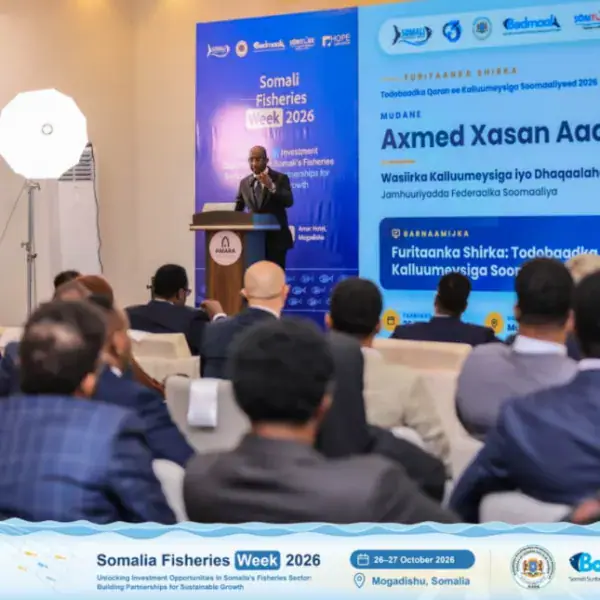
The 3rd Somali Fisheries Week, which opened in Mogadishu, was abruptly scaled back from a week-long international summit to a two-day event, stripped of multilateral backing and donor confidence. This stark contrast to previous editions highlights the severe institutional decay and systemic financial misappropriation plaguing the sector. The event's downscaled nature underscores the deep isolation of the ministry's current leadership.
The inaugural Somali Fisheries Week in September 2024 was a successful, multi-day national exhibition that brought together over ten major international donor partners, development agencies, local fishing cooperatives, and regional government delegations. The event aimed to leverage Somalia's 3,300 km coastline for sustainable local development. However, subsequent investigations revealed widespread irregularities and misappropriation of funds allocated by international development agencies.
The financial breaches led to the withdrawal of funding commitments from primary Western development partners, including the United States (USAID) and the United Kingdom (FCDO). The exit of key international backers sent shockwaves through the Ministry of Fisheries and Blue Economy, cutting off critical technical assistance, anti-piracy monitoring support, and coastal livelihood grants designed for local fishing communities.
Facing an acute budgetary crisis, Minister Ahmed Hassan Adan and Director General Abdi Dirshe bypassed standard parliamentary oversight, procurement laws, and constitutional checks to secure operational funding. They finalized a controversial, multimillion-dollar fisheries arrangement with Turkish representatives, brokered directly through the Turkish Embassy in Mogadishu. The agreement opens Somalia's rich Exclusive Economic Zone (EEZ) to foreign industrial commercial fleets.
Maritime legal experts, civil society organizations, and local coastal advocacy groups have condemned the transaction, asserting that the Minister and Director General have signed away Somalia's irreplaceable marine resources in exchange for short-term financial bailouts. The deal has raised concerns about the country's sovereignty and the impact on local artisanal fishers.
The improper involvement of Hope Labs Group, a private company, has compounded the governance scandal. The company was quietly contracted by the ministry to oversee key regulatory affairs, licensing mechanisms, and maritime compliance frameworks without fulfilling standard public bidding, statutory approvals, or legal vetting procedures. This opaque arrangement leaves local artisanal fishers vulnerable to unchecked industrial exploitation.
The 3rd Somali Fisheries Week stands as a stark warning of how crucial national developmental initiatives can be reduced to optics to mask administrative malfeasance. Without immediate parliamentary scrutiny, independent anti-corruption investigations, and a thorough audit of the bilateral agreements, Somalia risks permanently surrendering the economic sovereign rights of its greatest natural asset—its ocean.
Key points
- Somalia's fisheries sector faces crisis due to corruption and secret foreign deals.
- The country's blue economy vision is being undermined by institutional decay and systemic financial misappropriation.
- Donor flight and lack of transparency have exacerbated the crisis, threatening the livelihoods of local fishing communities.