Somalia's political scene is witnessing escalating tensions as a multifaceted power struggle unfolds. At its core, the conflict involves a deep-seated dispute between President Hassan Sheikh and the opposition, which seeks his resignation. However, this is not merely a binary confrontation; it encompasses an internal power-sharing struggle and external interests from foreign countries. The situation is complicated by the involvement of various stakeholders, including the federal government led by President Sheikh, the opposition divided into two factions, and foreign countries with close ties to Somali parties.
The opposition in Mogadishu holds significant political influence and reputation but lacks the administrative and military capabilities to directly pressure the president. Conversely, the presidents of Puntland and Jubaland, Said Abdullahi Deni and Ahmed Madobe, respectively, possess administrative, military, and territorial control, giving them substantial leverage. They aim to capitalize on these advantages, particularly before the end of December, to compel President Sheikh to reconsider his policies. Their strategy involves exerting pressure not only in Baydhabo but also through multiple fronts, potentially forcing the federal government into a broader security and political crisis.
The city of Baydhabo is a critical battleground in this struggle. If the opposition, led by figures like Laftagareen, manages to retake control of the city, it would constitute a significant political victory, weakening the federal government's position and demonstrating its inability to maintain control over its claimed territories. Additionally, Beledweyne has emerged as another focal point of pressure, with recent developments indicating a deterioration in security. The situation in Hirshabeelle, particularly regarding leadership and representation, has devolved into a security crisis, with armed groups and political figures becoming increasingly involved.
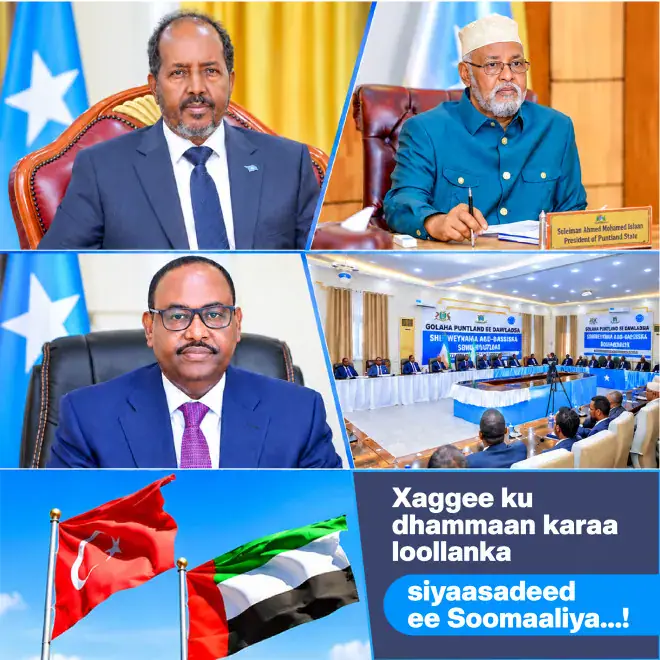
The involvement of foreign countries, notably Turkey and the United Arab Emirates (UAE), adds another layer of complexity to the conflict. Turkey maintains close ties and provides support to the federal government, while the UAE has interests and alliances with regional states like Puntland and Jubaland. This external dimension could influence the trajectory of the conflict, potentially threatening Somalia's decision-making autonomy if the parties continue to polarize.
President Hassan Sheikh faces numerous challenges that cannot be addressed through the resources of Villa Somalia alone. These include security concerns, particularly the ongoing conflict with Al-Shabaab, and the defense of Baydhabo. The president must also navigate the crisis in Hirshabeelle and address the impending withdrawal of Ugandan troops, necessitating a clear plan to fill the security vacuum. Furthermore, he needs to mend relations with neighboring countries and regional actors to limit the opposition's ability to garner external support.
The recent decision by the Supreme Court on November 5, regarding the presidential term and election process, has injected a new level of uncertainty into the conflict. The court's ruling and the government's response have propelled the dispute into a new phase, raising questions about whether the parties can agree on an acceptable electoral process. This development underscores the complexity of finding a resolution that satisfies all stakeholders.
As the situation unfolds, two primary scenarios emerge. The opposition could achieve a political victory if the Puntland and Jubaland presidents unite their efforts and succeed in having Laftagareen regain control of Baydhabo. Alternatively, if the pressure in Baydhabo is compounded by escalating tensions in Beledweyne and other security challenges, the federal government could face a more extensive and complex crisis, potentially creating an opportunity for the opposition to press for concessions from President Sheikh.
Key points
- The conflict in Somalia involves a complex interplay of internal power struggles and external interests.
- The opposition's ability to exert pressure on President Sheikh will depend on its capacity to unite and garner support from regional leaders and foreign backers.
- The outcome of the power struggle will significantly impact Somalia's stability, security, and future political trajectory.
Reporting sources
- 𝐗𝐚𝐠𝐠𝐞𝐞 𝐤𝐮 𝐝𝐡𝐚𝐦𝐦𝐚𝐚𝐧 𝐤𝐚𝐫𝐚𝐚 𝐥𝐨𝐨𝐥𝐥𝐚𝐧𝐤𝐚 𝐬𝐢𝐲𝐚𝐚𝐬𝐚𝐝𝐞𝐞𝐝 𝐞𝐞 𝐒𝐨𝐨𝐦𝐚𝐚𝐥𝐢𝐲𝐚…! · Hiiraan Online