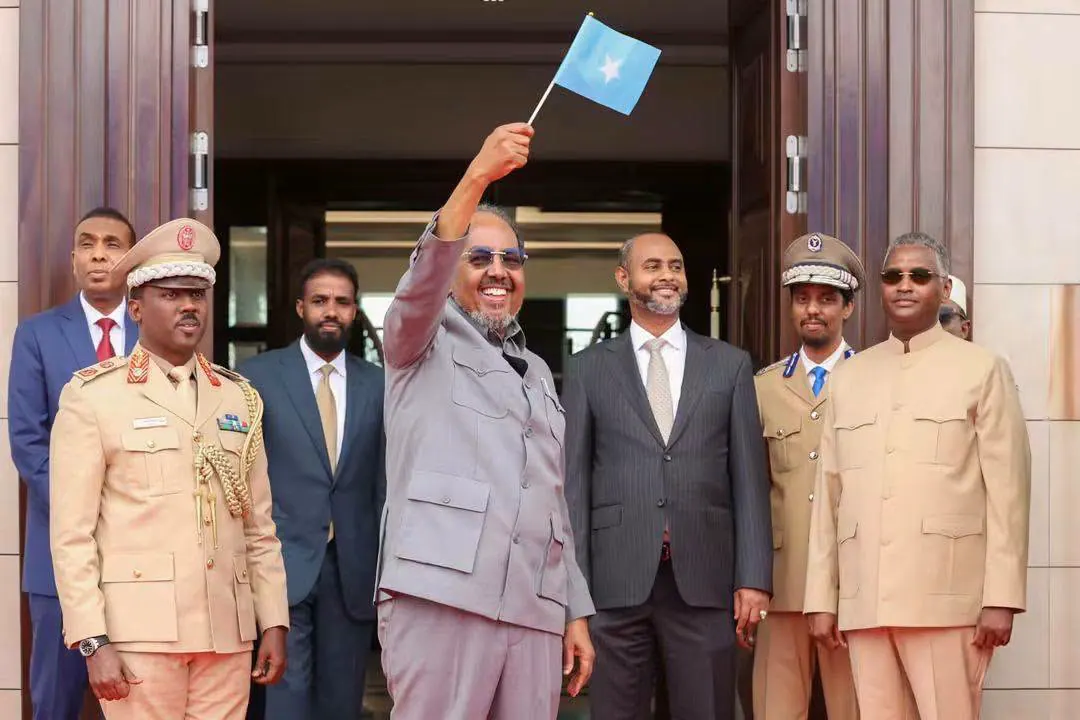
Somali President Hassan Sheikh Mohamud led a national ceremony marking the country's Flag Day at the presidential palace in Mogadishu. The event featured military units from the Somali National Army's land, air, and naval forces. The troops showcased their commitment to defending Somalia's flag, territorial integrity, and national sovereignty. The ceremony was attended by senior officials, including government leaders and military commanders. President Hassan Sheikh highlighted the significance of the occasion, emphasizing the flag's role in representing national unity and sovereignty.
The Somali flag was first raised on October 12, 1954, six years before the country gained independence in 1960. President Hassan Sheikh paid tribute to those who sacrificed their lives in the fight for independence, describing the flag as a symbol of national unity and the aspirations of Somalis who struggled for freedom. The flag features a white five-pointed star against a light blue background and was adopted on October 12, 1954. The star represents the five regions traditionally associated with the Somali people.
The annual commemoration of Flag Day brings together government officials and military leaders to celebrate the country's national identity and the legacy of its independence movement. Senior officials attending the ceremony included the speaker of the House of the People, the first deputy speaker of the Upper House, the prime minister, and the chief justice of the Supreme Court. The event highlighted the country's efforts to strengthen its national institutions and security forces amid persistent security challenges.
Somalia gained independence on July 1, 1960, when the former British Somaliland protectorate and the Trust Territory of Somaliland under Italian administration united to form the Somali Republic. The country's independence movement was shaped by aspirations for unity and self-determination. Flag Day remains an important national occasion, commemorating the origins of the flag and the country's struggle for independence.
The ceremony was held at the presidential palace in Mogadishu, a venue that symbolizes the country's national sovereignty. The event featured a military display by the Somali National Army's land, air, and naval forces, showcasing their capabilities and commitment to defending the country. The display highlighted the country's efforts to strengthen its security forces and national institutions.
The Somali government continues to face security challenges and political disagreements over the country's governance and electoral process. Despite these challenges, the government remains committed to strengthening national institutions and security forces. The commemoration of Flag Day serves as a reminder of the country's national identity and the legacy of its independence movement.
The country's national identity is deeply rooted in its history and the struggle for independence. The flag serves as a symbol of national unity and sovereignty, representing the aspirations of Somalis who struggled for freedom. The commemoration of Flag Day is an important occasion, highlighting the country's commitment to its national identity and the legacy of its independence movement.
Key points
- Somali President Hassan Sheikh Mohamud led a national ceremony marking the country's Flag Day at the presidential palace in Mogadishu.
- The Somali flag was first raised on October 12, 1954, six years before the country gained independence in 1960.
- The country's independence movement was shaped by aspirations for unity and self-determination, which are represented by the flag.