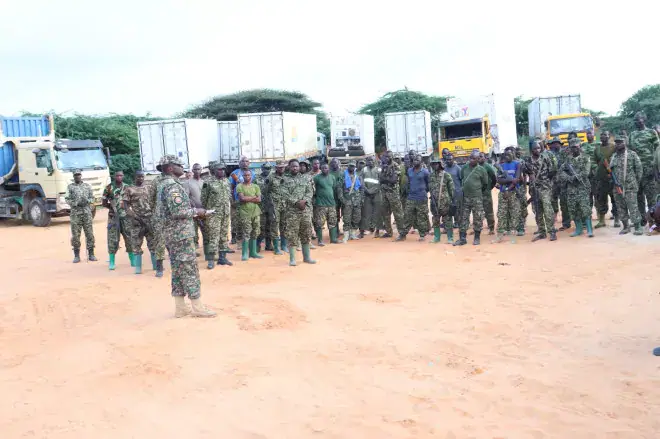
The Somali federal government has dismissed concerns that the withdrawal of Ugandan troops could create a security vacuum. Information Minister Abdifatah Qasim Mohamud said the Somali National Army is prepared to take over positions vacated by foreign forces. He emphasized that the government has spent recent years strengthening and training its armed forces, including soldiers who recently returned from military training abroad.
Ugandan troops have already handed over some of their positions directly to Somali forces as part of the ongoing security transition. The minister said foreign troops were deployed to Somalia for specific missions and limited periods, arguing that their departure should not be interpreted as evidence that Somalia lacks the military capacity to protect itself. He added that Somalia's security could not remain permanently dependent on international peacekeeping forces.
The Uganda People's Defence Forces (UPDF) announced earlier this month that it had begun withdrawing troops deployed under bilateral security arrangements with Somalia. The withdrawal will be conducted in phases, with all Ugandan troops, including those serving under the African Union Support and Stabilization Mission in Somalia (AUSSOM), expected to leave by the end of 2027. Uganda has been one of the largest contributors to African Union peacekeeping operations in Somalia since 2007.
The planned withdrawal has raised concerns among some security officials and lawmakers about the readiness of Somali forces to assume responsibility for strategic locations previously protected by Ugandan troops. Lawmaker Kooshin warned that Somalia was not yet prepared to take full control of areas vacated by Ugandan peacekeepers. He argued that security in Mogadishu and parts of Lower Shabelle and Middle Shabelle remained dependent on African Union forces.
Responding to the criticism, Abdifatah questioned whether areas that had previously fallen under al-Shabab control had been liberated exclusively by Somali troops or with the support of international peacekeepers. He maintained that the Somali National Army had played the leading role in liberating several areas from the militant group, citing military operations between Mogadishu and Harardhere as examples. The minister said the federal government had made significant investments in military training and capacity-building over the past five years.
Despite these assurances, concerns about the withdrawal have also been raised by international security officials. An African Union communication warned that the departure of Ugandan forces could leave parts of Lower Shabelle vulnerable to attacks by al-Shabab. Somalia's State Minister for Foreign Affairs, Ali Mohamed Omar, also acknowledged that a sudden withdrawal could create security problems, although he said the situation was not immediately critical.
Al-Shabab, an al-Qaeda-linked militant group, continues to carry out attacks against Somali security forces and maintains a presence in parts of southern and central Somalia. Abdifatah reiterated that the government was confident in the national army's ability to assume greater security responsibilities as Ugandan and other foreign troops gradually withdraw. The differing assessments reflect continued debate over Somalia's readiness to complete the security transition as African Union troop-contributing countries review their deployments and international funding remains uncertain.
Key points
- The Somali government has dismissed concerns about a potential security vacuum as Ugandan troops withdraw.
- The withdrawal of Ugandan troops is expected to be completed by the end of 2027.
- The Somali National Army has been strengthened through training and capacity-building efforts.
Reporting sources
- Somalia dismisses security vacuum fears as Ugandan troops withdraw · Hiiraan Online