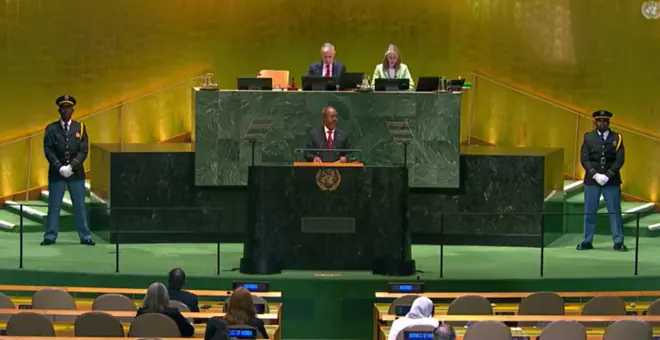
Somali President Hassan Sheikh Mohamud addressed the 81st session of the U.N. General Assembly, calling for sweeping reform of the United Nations Security Council and stronger Somali control over international assistance. He emphasized that Somalia is not seeking an end to the United Nations presence in the country but wants international assistance to work through Somali institutions rather than parallel systems. Mohamud's speech highlighted the need for a more accountable, strategic, and result-based relationship with the UN.
Mohamud argued that more than three decades of U.N. engagement in Somalia had produced important support but also created challenges. He stated that aid delivered through separate projects and structures outside the national budget made it difficult for the government to coordinate spending, measure results, and build lasting institutions. The president called for changes to the Security Council, citing Africa's unfair exclusion from permanent membership and inadequate representation among non-permanent members.
The Somali President expressed support for the African Union's common position seeking greater African representation in both categories of the council. He described Africa's exclusion from permanent membership as a "historical injustice" affecting 54 sovereign states. Mohamud emphasized that African countries should have full and equal representation when decisions affecting the continent are made. Somalia currently holds a non-permanent seat on the Security Council and is also a member of the African Union Peace and Security Council.
Mohamud reaffirmed Somalia's position on sovereignty and territorial integrity, rejecting unilateral actions that undermine the country's internationally recognized borders. He also reiterated Somalia's support for Palestinian self-determination and an independent Palestinian state based on the 1967 borders. The president emphasized that a two-state solution remained essential to lasting peace in the Middle East.
The president highlighted his government's push toward universal suffrage, describing it as an effort to hold Somalia's first democratic elections since 1969. He said constitutional reforms were intended to create a multi-party political system in which citizens directly choose their representatives and political disputes are resolved through law, dialogue, and elections rather than violence. Mohamud invited the United Nations and other international partners to support the transition while respecting Somali ownership of the country's democratic process.
Mohamud discussed Somalia's security transition, emphasizing the country's commitment to fighting militant groups and strengthening national security institutions. He called for predictable and sustained financing for Somalia's security transition, including adequate funding for the African Union mission. The president also argued that international financing should focus more heavily on prevention rather than repeatedly paying for humanitarian emergencies after they occur.
The president raised concerns about the economic impact of instability around the Strait of Hormuz, citing the disruption's contribution to higher prices, inflation, and insurance costs. He linked the disruption to an estimated 40% fall in Somalia's customs revenue, which would otherwise support economic reform, growth, and poverty reduction. Mohamud closed by calling for reforms not only at the Security Council but also in the international financial system, arguing that developing countries need financing that is affordable, accessible, and available quickly enough to respond to economic and climate shocks.
Key points
- Somali President Hassan Sheikh Mohamud calls for sweeping reform of the United Nations Security Council.
- Mohamud emphasizes the need for stronger Somali control over international assistance.
- The president highlights Somalia's push toward universal suffrage and democratic elections.