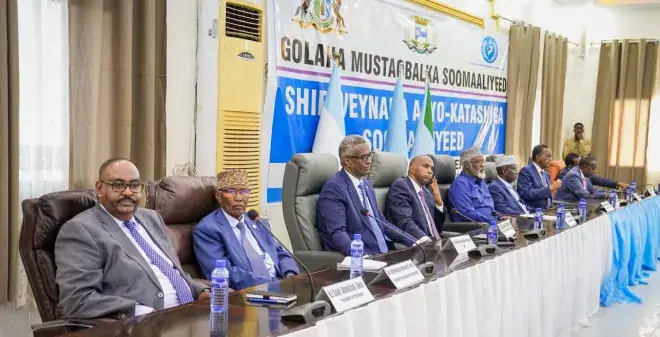
The Somali Future Council has denied allegations that opposition groups are planning to form an armed faction, insisting that they intend to seek political power through peaceful means amid growing tensions over the country's electoral process. Council secretary and federal lawmaker Abdullahi Arab rejected claims that the opposition was preparing an armed rebellion against President Hassan Sheikh Mohamud's government. Arab emphasized that the council's goal is to achieve power through peaceful means.
Arab made the statements in an interview with local media, addressing speculation about the council's intentions. He specifically denied that Abdirahman Mohamed Abdullahi Sanbaloolshe, a former director of the National Intelligence and Security Agency (NISA), was a member of the Somali Future Council. Sanbaloolshe's recent political activities have sparked debate about efforts to unite groups opposed to Hassan Sheikh's administration.
The Somali Future Council has not reached a final decision on its next political steps, including its response to the federal government's invitation to national consultations. Arab stated that members would discuss the available options internally before announcing a collective decision to the public. This comes after Hassan Sheikh invited the Somali Future Council and other stakeholders to a national consultative forum scheduled for November 14-18 in Mogadishu.
The proposed talks aim to address disagreements over federal elections and seek a political consensus among competing stakeholders. Somalia's National Independent Electoral and Boundaries Commission has scheduled parliamentary elections for April 15, 2027, followed by a presidential election on May 15. However, the Somali Future Council and other opposition groups have rejected the timetable, arguing that it was announced without an inclusive political agreement.
The federal government maintains that the electoral schedule complies with the country's revised constitutional framework and election laws. Arab argued that Hassan Sheikh's presidential term had expired, reflecting the opposition's rejection of constitutional changes extending the mandates of federal institutions. He also criticized previous efforts at political dialogue, arguing that opportunities to resolve disagreements through negotiations had not been fully utilized.
The Somali Future Council's stance on peaceful competition for power comes amid heightened tensions in the country. Arab emphasized that the opposition would continue discussing its political response while maintaining its commitment to peaceful competition for power. This approach is seen as a significant development in the country's ongoing electoral disputes.
The national consultative forum is expected to bring together various stakeholders, including the Somali Future Council, the Nabad iyo Nolol Party, the National Unity Forum, and civil society representatives. The forum's outcome could significantly impact the country's electoral process and the relationship between the government and opposition groups. The talks may help to address the current impasse and pave the way for a more inclusive and peaceful electoral process.
Key points
- The Somali Future Council denies allegations of forming an armed faction.
- The council insists on seeking power through peaceful means.
- The national consultative forum aims to address electoral disputes and promote a political consensus.