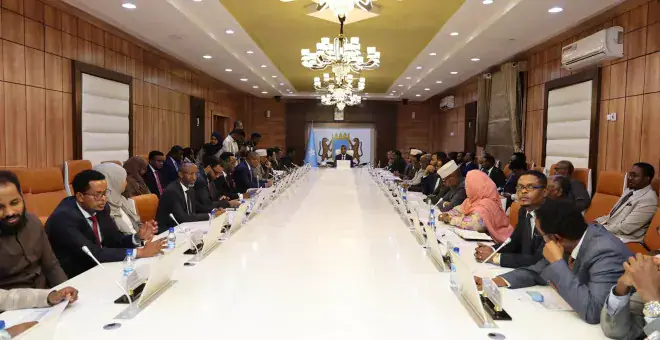
The Somali Council of Ministers has approved amendments to the country's electoral and political party laws. This development is a step towards reforming the electoral system ahead of the 2027 national elections. The amendments were approved during an extraordinary Cabinet meeting chaired by Prime Minister Hamza Abdi Barre. The changes aim to align the laws with Somalia's revised Federal Constitution.
The approved amendments change 23 articles of the National Electoral Law and eight articles of the Law on Political Organizations and Parties. The Cabinet's statement said these changes are necessary to implement the Constitution. The laws were enacted before the Constitution was adopted and now need to be aligned with its provisions. The amendments introduce a closed-list system for parliamentary elections.
Under the closed-list system, voters choose political parties or organizations rather than individual candidates. Parliamentary seats are allocated according to electoral results and the candidates' positions on their respective lists. The amendments also establish a threshold for political organizations to qualify as national political parties. Organizations must secure at least 10% of the vote in federal elections to gain recognition.
The Cabinet's decision is a step towards implementing the government's proposed electoral system. However, the changes have not yet been enacted into law and require legislative approval. Somalia is preparing for parliamentary elections scheduled for April 15, 2027, and a presidential election planned for May 15. The electoral commission has continued preparations despite ongoing political disagreements.
Opposition coalitions and the administrations of Puntland and Jubaland have rejected constitutional changes adopted by the federal government. They argue that the changes were introduced without sufficient political consultation and consensus. The federal government maintains that the constitutional amendments provide a legal basis for implementing the revised electoral framework and holding elections in 2027.
The National Independent Electoral and Boundaries Commission (NIEBC) will establish technical procedures and mechanisms for voter registration and voting. The amendments aim to facilitate public participation in elections and provide a legal framework for implementing the country's constitutional provisions. The Cabinet's decision comes as the federal government continues efforts to reform the electoral system.
The proposed electoral reforms have not resolved ongoing political disagreements between the federal government and opposition groups. The electoral commission recently extended the deadline for political organizations to submit registration documents from Nov. 22 to Nov. 30. The Cabinet-approved amendments represent another step toward implementing the government's proposed electoral system.
Key points
- The Somali Cabinet has approved amendments to the electoral and political party laws.
- The amendments introduce a closed-list system for parliamentary elections.
- The changes aim to align the laws with Somalia's revised Federal Constitution.