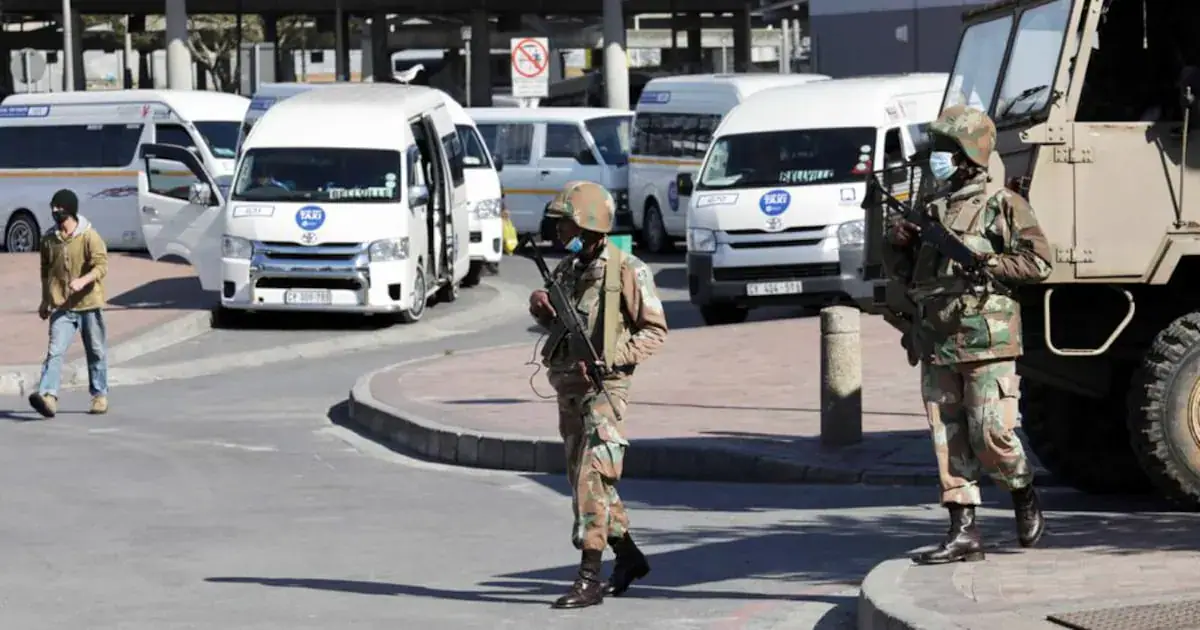
A recent video circulating online showed Cape Town International Airport experiencing slow service due to staff being unable to get to their shifts as a result of ongoing minibus taxi violence in the city. This incident highlights how social problems can easily affect people from various backgrounds and circumstances. The violence in Cape Town has become a familiar feature of breaking news, with many people consuming these stories, condemning them, and moving on. However, for those directly affected, the situation is far from over.
The intersection of social problems, including violence, poverty, and insecurity, can have far-reaching consequences that cannot be contained within specific class boundaries. According to social commentator Itshokeng Kekana, no one is above their experiences simply because of their class. The consequences of social problems can eventually reach people who have, until now, been able to create distance between themselves and the experiences of those living with these realities every day.
The minibus taxi violence in Cape Town has been a long-standing issue, with many people losing their lives or having their livelihoods compromised. However, it is only when these problems start to affect the routines and privileges of the middle and upper classes that they begin to receive more attention. Kekana argues that class immunity is an illusion, and economic privilege cannot eliminate our dependence on the people experiencing social problems.
The poor are not simply recipients of society's failures; they are workers, service providers, commuters, and contributors to the everyday functioning of society. Their experiences cannot continually be treated as someone else's problem while their labor and participation remain essential and needed for everyone else's lives. A society cannot indefinitely outsource its problems to the poor and expect the consequences to remain with them.
The long-term solution to violence in communities is everyone's concern, not only because its consequences can eventually reach across class boundaries but also because the people most affected by it are participants in sustaining the society that often neglects them. It is essential to reconsider how we respond to social problems before they begin interfering with the routines and privileges we have come to take for granted.
The current situation in Cape Town serves as a reminder of the interconnectedness of social realities. As Kekana notes, we sometimes behave as though the problems experienced by one class can be contained within that class. However, this is not the case, and it is crucial to confront the contradiction that we cannot continue to depend on people whose social realities we are unwilling to confront.
Ultimately, the consequences of social problems, such as violence in Cape Town, will continue to affect people across different classes and circumstances until a collective effort is made to address these issues. By acknowledging the interdependence of society and the importance of confronting social problems, we can work towards creating a more equitable and just society for all.
Key points
- Social problems in South Africa, such as violence in Cape Town, have consequences that can reach people across different classes and circumstances.
- Class immunity is an illusion, and economic privilege cannot eliminate our dependence on the people experiencing social problems.
- The long-term solution to violence in communities is everyone's concern, and it requires a collective effort to address these issues.