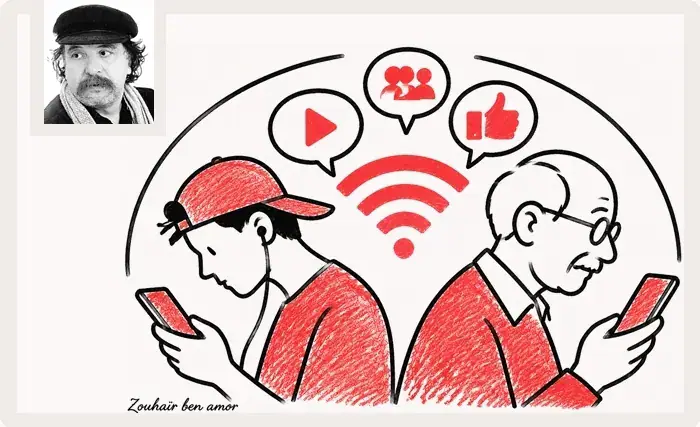
The way families interact in Tunisia has undergone a significant transformation due to social media. A typical family gathering now shows grandparents looking at photos sent by their grandchildren, parents responding to work messages, and teenagers switching between videos and group chats. Although they are in the same room, each person seems to be in a different space. This scene, common in many Tunisian households, highlights the profound impact of social media on intergenerational relationships.
Social media has changed the way people communicate, especially across different generations. For those who grew up without the internet, communication relied on face-to-face meetings, phone calls, and visits. News was shared during meals, celebrations, and social gatherings. In contrast, young generations have grown up with almost constant communication, sending photos, voice notes, and videos instantly. They do not necessarily view digital messages as less real than in-person interactions.
The difference in communication habits between generations can lead to misunderstandings. In Tunisia, this evolution is particularly noticeable in families with members living abroad, in other regions, or away from home for work or studies. Messaging apps allow families to share updates, wish each other happy birthday, and ask about elderly parents or show off a child's milestones. A grandparent can see their grandchild grow up from a distance, and a parent working abroad can participate in family moments remotely.
Social media has altered the flow of conversation and information within families. Previously, information and cultural references were mainly passed down from adults to young people. Today, the flow has become more reciprocal. Teenagers teach their parents how to use apps, set phone settings, and make video calls. Children sometimes become their elders' digital guides. This role reversal can be enriching, as it emphasizes that transmission is not a one-way process.
Despite the benefits, intergenerational encounters on social media do not always occur without tension. Cultural references, language codes, and concepts of private life can differ significantly. A photo posted by a teenager may seem harmless to them but intrusive to their parents. An adult's comment on a video or outfit can be perceived as judgment by the young person. The silence of a teenager in response to a family message may be interpreted as disrespect when it is simply a communication habit or a desire to preserve personal space.
Social media also makes visible the different worlds that previously coexisted with little interaction. Parents discover their children's music, comedians, debates, and concerns. Young people can follow their grandparents' activities, neighborhood stories, and accounts from a generation that did not usually share their lives publicly. This visibility can spark unexpected conversations but may also lead to comparisons and misunderstandings, especially when individuals comment on each other's choices without seeking to understand them.
The paradox of social media is that it enables constant communication without ensuring genuine availability. A person can send many messages in a day but fail to listen attentively to someone right in front of them. Digital conversations are often fragmented, occurring between tasks, interrupted by notifications, and relying on quick responses. Certain issues, such as a teenager's worry, marital difficulties, or the loneliness of an elderly parent, require time, silence, and attention to resolve.
Key points
- Social media has transformed intergenerational relationships in Tunisia, creating both connections and distances within families.
- The impact of social media on relationships depends on how it is used and the role it plays in family communication.
- Intergenerational dialogue on social media can be a form of mutual learning, where young people transmit technical skills and new languages, and elders share experience and human memory.