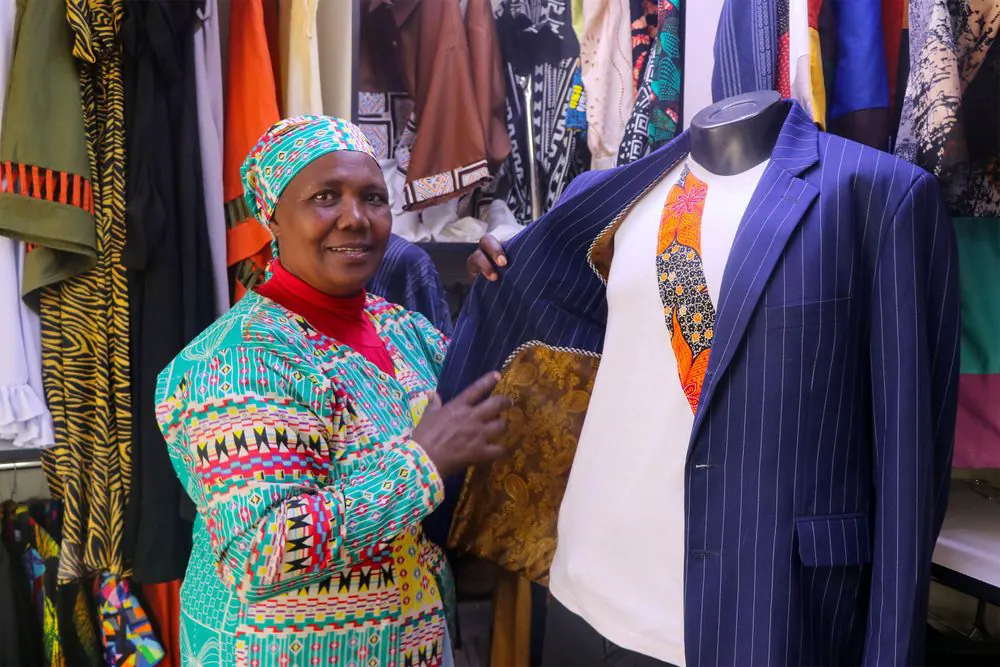
In a workshop on the outskirts of Kenya's Kitengela town, women are working in rows, seated in front of specialised sewing machines, producing garments and learning new skills. The workshop belongs to Tuwe Bora, a social enterprise founded by Linda Sigilai, which uses garment production as a pathway into work for women, refugees, and marginalised youth. Sigilai, a nutritionist by training, had spent six years working in public health before she moved into fashion in 2019.
Tuwe Bora started in 2019 as an informal support group where five young mothers met to exchange income-generating skills. Membership eventually grew to 100 before the group became Tuwe Bora Ltd in June 2021. The organisation later expanded its work to young people without higher education and refugee communities, providing them with skills and employment support. Sigilai realised that employment alone was not enough and that social inclusion was a major issue.
Teresa Njoroge, founder and chief executive officer of Clean Start Africa, said poverty was a major factor behind the incarceration of women. A May 2025 study found that 70 percent of women who are incarcerated are incarcerated due to petty survival offences. Njoroge knew the challenge personally, having spent time in prison after being wrongfully convicted.
For women leaving prison, the difficulty often continued after release. Without stable housing, employment or support networks, some returned to the same circumstances that had contributed to their incarceration. Njoroge said that the revolving door of poverty and incarceration continues to perpetuate because the root cause of their being arrested is not addressed.
At Tuwe Bora, some of the women already knew how to sew, but the challenge was adapting those skills to the equipment and quality standards demanded by the market. Joyce Wanja, a 60-year-old woman who spent 13 years in prison, is one of those women. She had learnt to sew in prison but needed to adapt her skills to modern machines and international requirements.
Wanja spent about two years training at Tuwe Bora before starting her own business in Kitengela. She now makes school bags, laptop bags, and custom clothing. Sigilai works directly with Kajiado Women’s Prison, where she established a textile centre and supplied machines and training. The aim is for women to leave prison with skills they could use to start businesses or find employment.
The enterprise generates revenue through its upcycled garment line, white-label production for corporate clients, and paid short courses that train people for employment within four weeks. Sigilai's goal is to give people the skills and support to build livelihoods independently, and she finds satisfaction in seeing women like Wanja transition back into their communities successfully.
Key points
- Tuwe Bora provides training and employment opportunities to women, refugees, and marginalised youth in garment production.
- The organisation aims to address social inclusion and poverty, major factors behind incarceration.
- Tuwe Bora's sustainable business model combines social impact with commercial viability.