The Canoe and Fishing Gear Owners Association of Ghana (CAFGOAG) plans to expand its Small-Scale Fisheries Academy from eight to 20 fishing communities across Ghana's four coastal regions. This initiative, supported by Mundus Maris, Blue Ventures, the Ministry of Fisheries and Aquaculture, and the Fisheries Commission, aims to provide a platform for fishers and industry players to identify challenges and develop practical solutions. The academy seeks to give fishing communities greater ownership of efforts to protect and sustain the country's fisheries resources.
General Secretary of CAFGOAG, Kenneth Arthur, emphasized the importance of fisher participation in decision-making processes affecting the industry. He stated that fishers possess valuable knowledge and solutions to the challenges confronting them and that interventions developed without sufficient community involvement often fail to achieve lasting results. The academy equips fishers with the knowledge and skills to identify challenges and develop their own interventions, with facilitators taking lessons back to the communities to encourage practical application.
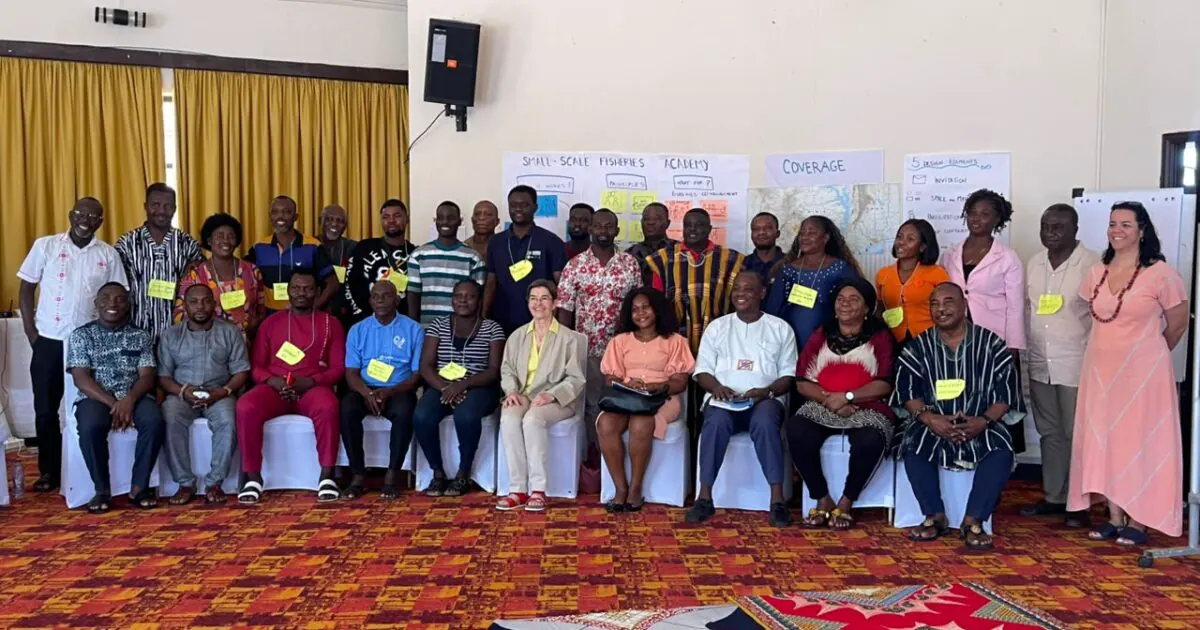
The second session of the Small-Scale Fisheries Academy, held in Elmina from September 28 to October 2, 2026, brought together 35 participants from Ghana's four coastal regions. The session aimed to strengthen community leadership and lay the groundwork for more effective fisheries co-management along Ghana's coast. Participants' skills in community facilitation, dialogue, leadership, and participatory planning were strengthened to help local facilitators bring together different groups within fishing communities to discuss fisheries challenges.
President of Mundus Maris, Dr. Cornelia Nauen, called for stronger support for small-scale fishing communities in Ghana, warning that overfishing and destructive practices threaten the sustainability of the country's marine resources. She emphasized the need for a shift from extractive fishing practices to community-led efforts that recognize the knowledge and experience of artisanal fishers. Dr. Nauen cited the collapse of cod stocks off Newfoundland in Canada as a warning of what could happen when fishing exceeds the ocean's capacity to replenish itself.
Dr. Nauen highlighted the potential for Ghana to build a more resilient fisheries sector by harnessing the knowledge of fishing communities and combining it with scientific and technical expertise. She emphasized the importance of women in Ghana's fisheries sector, describing them as central to the industry's economic survival and the wellbeing of fishing families. Women play a critical role in fish processing, marketing, and other aspects of the industry.
The Small-Scale Fisheries Academy uses a co-management approach that recognizes fishers as critical partners in addressing industry challenges. The academy focuses on practical ways of communicating fisheries management concepts to participants, using drawings and visual materials to make lessons easier to understand. This approach enables fishers to identify challenges and develop their own interventions, with facilitators providing support and guidance.
The expansion of the Small-Scale Fisheries Academy is expected to promote sustainable fisheries management and create wider development opportunities for coastal communities. Sustainable fisheries management can lead to improved sanitation, better schools, healthcare, and stronger local businesses. The academy's focus on community-led efforts and fisher participation is seen as key to achieving these goals and ensuring the long-term sustainability of Ghana's fisheries resources.
Key points
- The Small-Scale Fisheries Academy will expand to 20 communities across Ghana's four coastal regions.
- The academy aims to promote inclusive dialogue and sustainable fisheries management.
- Women play a critical role in Ghana's fisheries sector, particularly in fish processing and marketing.