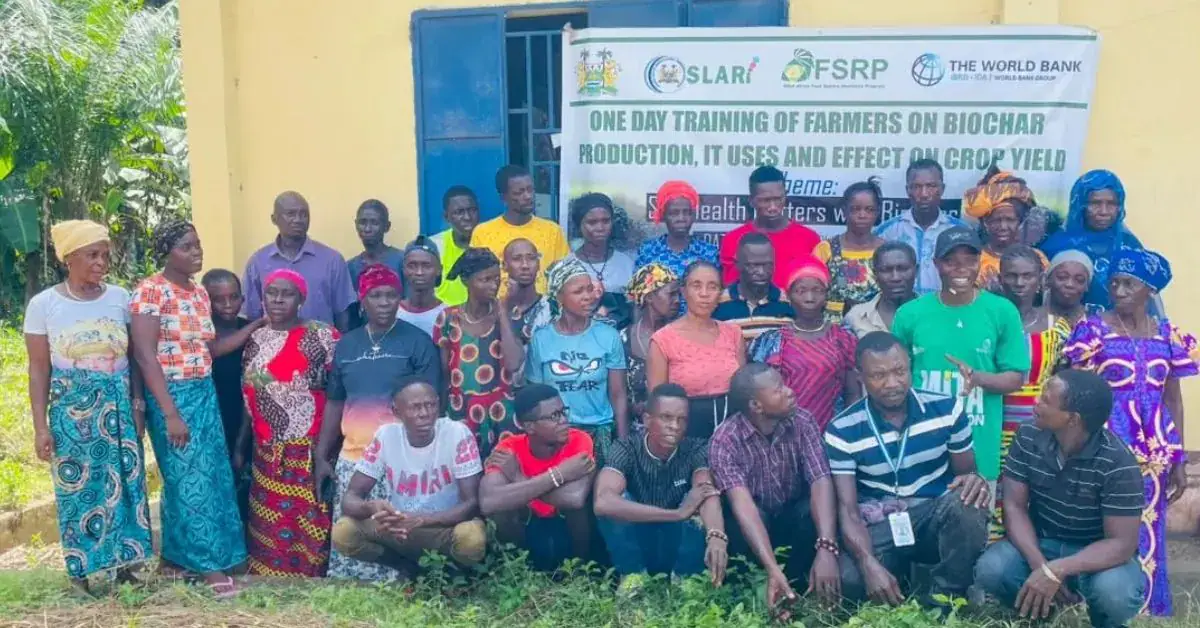
The Sierra Leone Agricultural Research Institute (SLARI) has introduced farmers to biochar technology to improve soil fertility, increase crop yields, and promote sustainable agriculture. Through SLARI's Magbosi Land, Water and Environment Research Centre (MLWERC), farmers learned to produce biochar from agricultural waste like rice husks. This initiative is part of an FSRP-SL-funded research project led by Soil and Water Engineer Hindolo Andrew Bebeley.
The training enabled participants to convert agricultural residues into a valuable resource for restoring soil health and supporting improved crop production. Farmers learned how to turn waste into a practical and affordable solution to declining soil fertility. One participant, Alhaji, expressed excitement about the technology, citing its potential to provide a solution that is practical, affordable, and within their reach.
Research conducted across Port Loko, Tonkolili, Moyamba, and Kenema districts revealed strong interest among farmers in adopting the technology. Over 90 per cent of those surveyed expressed willingness to learn how to produce biochar. The research supports the objectives of the Feed Salone initiative by promoting locally driven agricultural solutions to strengthen food security and improve farmers' livelihoods.
The biochar technology has the potential to enhance water retention and increase cassava productivity on degraded agricultural land. SLARI's initiative aims to address the challenges of soil degradation and declining fertility, which affect crop yields and farmers' livelihoods. By promoting sustainable farming practices, SLARI seeks to improve food security and support the country's agricultural sector.
The Feed Salone initiative is a key program aimed at strengthening food security, improving farmers' livelihoods, and encouraging sustainable farming practices in Sierra Leone. SLARI's biochar technology project aligns with this initiative by promoting locally driven agricultural solutions. The project's success could have a positive impact on the country's agricultural sector and food security.
SLARI's efforts to promote sustainable agriculture and improve soil fertility are crucial for the country's agricultural development. The institute's research and training programs aim to equip farmers with the knowledge and skills needed to adopt sustainable farming practices. By supporting farmers in adopting biochar technology, SLARI can help improve crop yields and enhance soil fertility.
The introduction of biochar technology in Sierra Leone has the potential to transform the country's agricultural sector. With the support of SLARI and other organizations, farmers can adopt sustainable farming practices that improve soil fertility, increase crop yields, and promote food security. As the country continues to grapple with the challenges of food insecurity and soil degradation, initiatives like SLARI's biochar technology project offer a promising solution.
Key points
- SLARI introduces biochar technology to improve soil fertility and crop yields in Sierra Leone.
- Over 90 per cent of farmers surveyed expressed willingness to learn how to produce biochar.
- The biochar technology project aligns with the Feed Salone initiative to promote locally driven agricultural solutions.