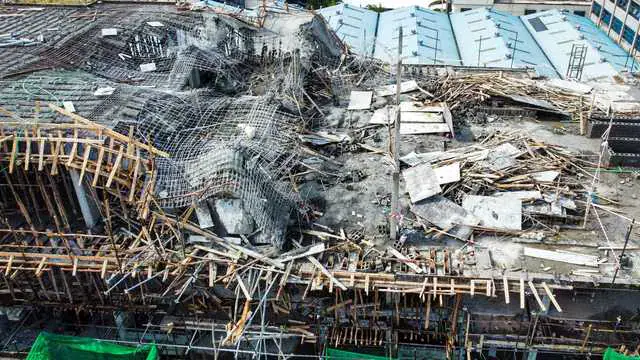
A devastating incident occurred in Syokimau, Nairobi, on Friday, November 13, 2026, when an eight-storey building under construction collapsed, resulting in the deaths of six people and injuring five others. The building was located along Mombasa Road, and authorities reported that all 405 people in the surrounding area had been accounted for. The incident prompted a rapid response from Nairobi County firefighters and a rescue team, who were dispatched to the scene to search for survivors and ensure no one was trapped.
This tragic event has raised concerns about building safety and accountability in Kenya's construction sector. According to the Ministry of Lands, Public Works, Housing, and Urban Development, 100 buildings have collapsed in the country over the past 30 years, resulting in over 40 fatalities in the last five years. In 2022, 13 buildings collapsed, while 12 incidents were recorded in both 2021 and 2023. The National Construction Authority (NCA) has conducted inspections, revealing that many buildings are constructed without adhering to required permits and standards.
The NCA's inspection of 21,282 buildings under construction in 14 areas between July 2025 and April 2, 2026, found that 12,018 had been halted due to violations, while only 9,264 met the required standards. This represents a compliance rate of 43.5%. Nairobi had the highest number of inspected construction sites, with 3,908 sites checked, of which 1,647 were halted. The compliance rate in Nairobi was 57.86%. The former Western province had the highest compliance rate at 77.83%, while the North Eastern region had the lowest at 5%.
Experts from the Kenya Institute for Public Policy Research and Analysis (KIPPRA) attribute building collapses to poor workmanship, substandard materials, inadequate supervision, and design flaws. The NCA has the authority to halt construction projects and take action against violators, with a team of 15 police officers to aid in inspections and enforcement. Under the National Construction Authority Act, individuals who refuse to comply with inspectors' orders can face fines of up to KES 1 million, imprisonment for up to three years, or both.
Despite these regulations and enforcement mechanisms, building collapses continue to occur. Between 2025 and 2026, the NCA successfully secured 15 convictions in various construction-related cases. However, the authority's report notes that not all investigations into building collapses are completed, and perpetrators are not always held accountable. This has raised concerns that violators are not being adequately deterred from continuing to risk people's lives.
The 2024 National Building Regulations require construction projects to adhere to architectural, engineering, and construction standards. They also mandate that design and supervision be carried out by registered professionals. Nevertheless, the persistence of building collapses has sparked questions about whether developers and building owners are being held accountable. For families who lose loved ones in such incidents, the issue is not only understanding the cause of the collapse but also ensuring that those responsible are held accountable and that such incidents do not recur.
The recent incident in Syokimau is the second major building collapse in less than a month. On October 23, 2026, an 18-storey building in Eastleigh, Nairobi, collapsed, killing eight people and leaving others missing. As authorities investigate the cause of the Syokimau incident, concerns about building safety and regulatory enforcement continue to grow.
Key points
- Six people died when an eight-storey building under construction collapsed in Syokimau, Nairobi, on November 13, 2026.
- The National Construction Authority has conducted inspections, revealing widespread non-compliance with building regulations.
- Experts cite poor workmanship, substandard materials, and design flaws as contributing factors to building collapses in Kenya.
Reporting sources
- Wanalala kazini majengo yakiendelea kuporomoka na kuua watu nchini · taifaleo.nation.co.ke