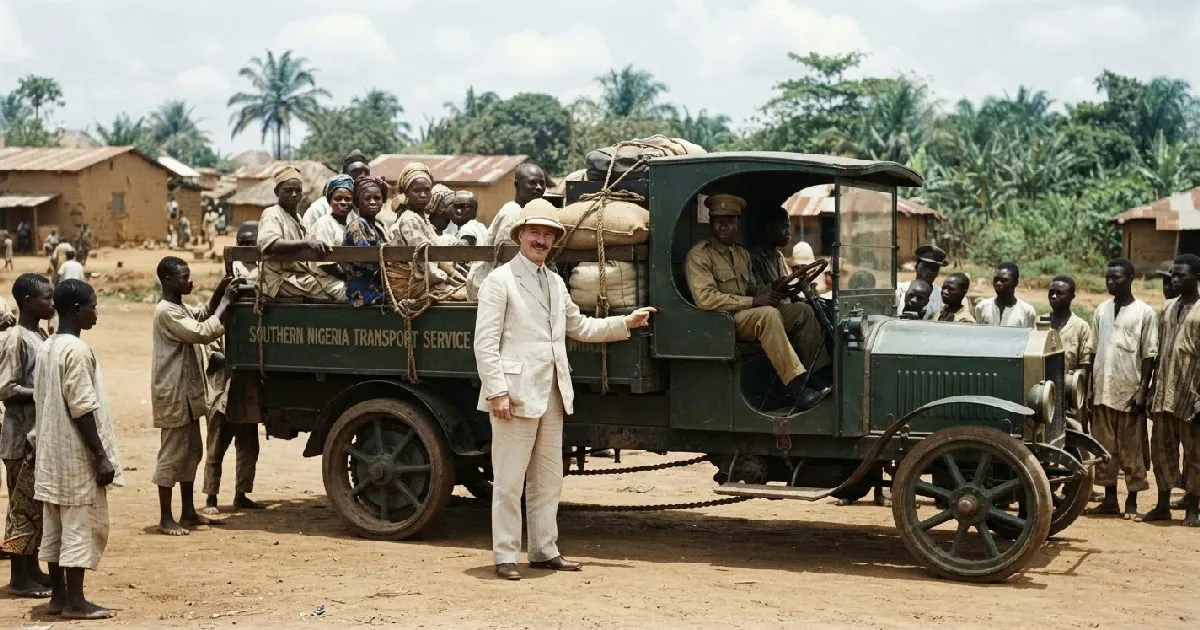
In January 1907, a single motor van started operating between Ibadan and Oyo, a distance of 33 miles, under the leadership of Sir Walter Egerton, the British colonial governor of Southern Nigeria. This pioneering venture aimed to connect the commercial hub of Ibadan, which was the terminus for the Lagos Government Railway, to the inland town of Oyo. The initial vehicle was a delivery van with a 16-horsepower engine, capable of carrying 24 hundredweight. This marked a significant shift from traditional reliance on human porters and canoes.
The motor service rapidly expanded, with five vans operating on the Ibadan-Oyo route by 1908. These vehicles, including larger two-ton and three-ton capacity models, transported 1,086 tons of goods and 1,620 passengers during 1908 alone. The success of the service led to its extension to other areas, with vans deployed between Itu and Ikot Ekpene in eastern Southern Nigeria, and between Asaba and Okpanam near the River Niger. The Public Works Department in Lagos also began utilizing a motor vehicle, demonstrating the growing importance of motorized road transport.
Governor Egerton championed the use of paraffin, or kerosene, as a fuel source, deeming it cheaper and safer than petrol, especially in the tropical climate. This decision led to technical adaptations, with vehicles modified to run on paraffin. The first two vans were converted, and subsequent orders requested engines compatible with the alternative fuel. This pragmatic approach ensured the continuity of the transport service, highlighting the nascent state of Nigeria's energy infrastructure at the time.
The motor service also marked a significant milestone in the employment of African personnel. By January 1908, African drivers had taken over the operation of the service, demonstrating that local workers were capable of handling complex machinery. This development laid the groundwork for the broader development of technical and transport-related occupations within colonial Southern Nigeria.
The existence of the Ibadan-Oyo motor service was intrinsically linked to infrastructure development. The first purpose-built road for motorized vehicles in Nigeria, connecting Ibadan and Oyo, was constructed in 1906 under the guidance of Lord Lugard. The road was designed to facilitate the movement of agricultural goods and people, but early road conditions presented significant challenges. Sections were reinforced with locally sourced laterite, and 12 miles of the road were re-metalled in 1909.
The motor service created a new artery for trade, carrying passengers, imported goods, and agricultural produce. Travelling towards Oyo, the vans carried goods such as cement, timber, and cotton textiles, while returning with palm kernels, shea nuts, groundnuts, and cotton. This facilitated a more efficient flow of goods, though vans were often less loaded on return, reflecting export commodity flows versus import volumes.
Despite its impact on trade and connectivity, the Ibadan-Oyo motor service faced financial challenges. However, its legacy as a pioneering venture in motorized transport in Southern Nigeria remains significant. The service demonstrated the potential of motorized transport to accelerate commerce and integrate the region into the colonial economy.
Key points
- Sir Walter Egerton introduced motorized transport to Southern Nigeria in 1907.
- The Ibadan-Oyo motor service expanded rapidly, with five vans operating by 1908.
- African drivers took over the operation of the service by January 1908.