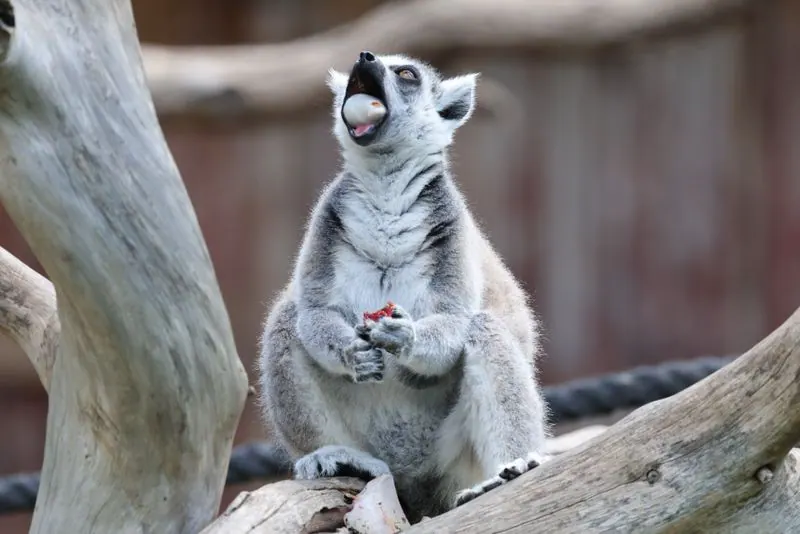
In the dense forests of northeastern Madagascar, lemurs called indris rely on haunting songs to communicate. Scientists have discovered that these primates open their mouths wider when producing higher-pitched notes, a pattern consistent with a vocal technique called formant tuning. This technique, also used by trained opera singers, allows the indris to boost the power and distance of their voices. The indris' songs are central to how family groups relate to the world around them.
The research, published in PLOS Computational Biology, analyzed 83 video recordings of 19 wild indris in Madagascar's Maromizaha forest and Mitsinjo reserve. Researchers tracked facial landmarks frame by frame and paired these with synchronized audio to test statistically whether mouth opening predicted pitch. The results showed a robust correlation between mouth opening and pitch. The indris' songs are described as long, loud, rising and falling notes, quite haunting and almost mournful to human ears.
The indris' songs serve multiple social functions, including territorial advertisement and reunification after separation. The songs are a way for indri family groups to advertise their presence across a landscape where visual contact is limited. Interestingly, these territorial songs tend to get longer when a group visually encounters another group nearby, as if the song is being reinforced by the direct sighting.
The indris hold their territories with striking precision, suggesting that their songs play a crucial role in spacing groups across the forest. This allows them to avoid many potentially dangerous confrontations that come with defending resources. According to researcher Filippo Carugati, this is a beautiful example of communication substituting for conflict.
The indris' vocal technique is similar to that of humans and other animals, such as singing gibbons and howling grey wolves. These species have independently evolved comparable solutions to make their voices heard at a distance. The indris' ability to modify their vocal tract to make sounds travel farther is crucial for their survival in the wild.
Unfortunately, the indris are critically endangered, with their numbers decreasing due to habitat loss and fragmentation. The Lemur Conservation Network reports that indris are the largest extant lemur species, and their survival ultimately depends on protecting them in the wild. Conservation efforts are necessary to preserve the indris' habitat and prevent their extinction.
The research highlights the importance of protecting the indris and their habitat. According to Chiara De Gregorio, study co-author, the indris' songs are not just beautiful sounds, but a way of staying connected to one another in the vastness of the forest. By studying the indris' vocal behavior, researchers can gain a deeper understanding of the complex social dynamics of these unique animals.
Key points
- The indris use formant tuning to boost the power and distance of their voices.
- The indris' songs serve multiple social functions, including territorial advertisement and reunification.
- The indris are critically endangered due to habitat loss and fragmentation.