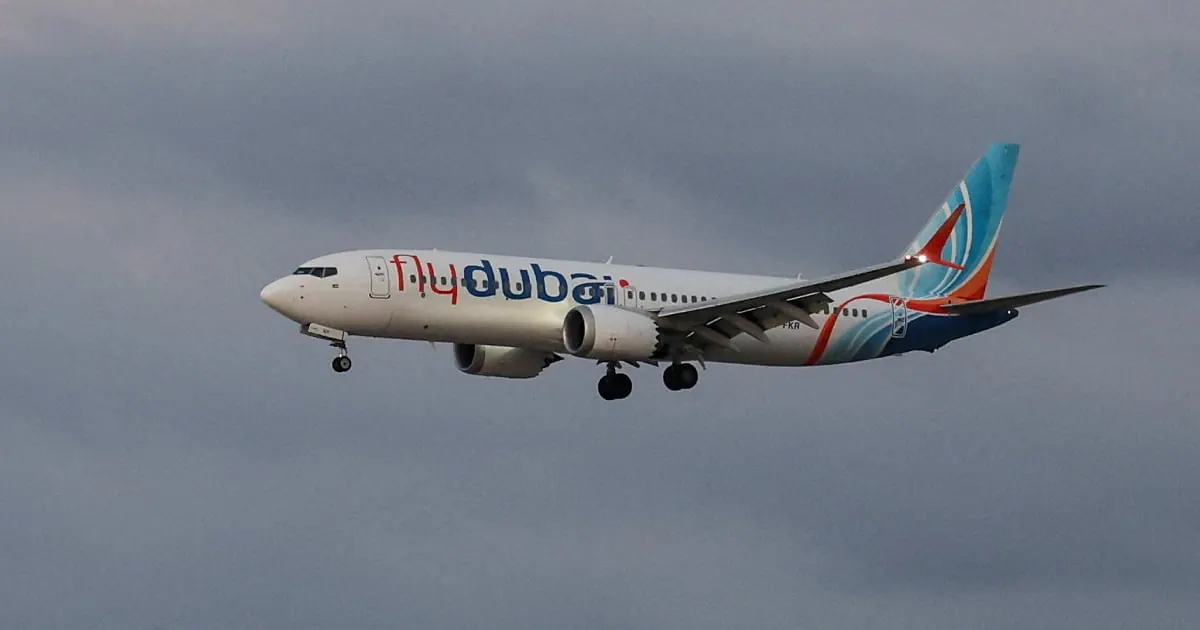
An aviation instructor has recreated the harrowing descent of Flydubai's flight FZ1073 in a flight simulator, revealing what passengers and crew experienced during the sudden plunge. On Wednesday, the Boeing 737 MAX 8 aircraft dropped 16,000 feet in about 30 seconds after the co-pilot attacked the captain with an emergency crash axe. Instructor Alberto Paduanelli, owner of ALPA Simulation in southern England, used a simulator to recreate the incident, describing it as a "vertical roller coaster" with a steep fall that would have put huge strain on the aircraft and those on board.
The incident, described as a "terrorist attack" by the United Arab Emirates prosecutor general, occurred on a flight bound for Israel from Dubai. The co-pilot, identified as Hammam al-Hammami, an Omani national, allegedly attacked the pilot with an emergency crash axe. UAE authorities have not confirmed al-Hammami's identity, and Reuters could not reach him for comment. Flydubai has stated that the circumstances surrounding the incident are still under investigation and that it cannot comment further.
Paduanelli's simulation revealed that the aircraft's autopilot disconnected before the plunge began, causing the jet to accelerate rapidly. Passengers who were not strapped in would have felt a negative g-force, with their bodies literally lifting from their seats. The instructor emphasized that a sudden drop of 16,000 feet over 30 seconds would be an extremely intense experience, unlike a roller coaster where the outcome is known.
The plane was levelled out after passengers overpowered the co-pilot, and a reserve crew of pilots on board landed the plane safely. US President Donald Trump praised the Boeing jet for withstanding the severe forces put on it during the incident, calling it an "amazing show of precise and powerful structural planning and design." Boeing has not responded to requests for comment.
Aircraft are designed and tested to withstand substantial aerodynamic loads, but a prolonged high-speed dive can place extreme strain on an airframe. Paduanelli described the incident as a "miracle" that no one was seriously hurt apart from the captain. The incident has raised questions about the co-pilot's background, with details emerging about his past.
According to Royal Air Maroc, al-Hammami completed a three-month training program with the airline in 2025, but his application to work there afterwards was rejected. Buckinghamshire New University in Britain confirmed that he completed a distance-learning course in aviation management, but not pilot training. An Australian Federal Police spokesperson said authorities were investigating al-Hammami's "links to Australia."
The investigation into the incident is ongoing, with a source briefed on the investigation revealing that al-Hammami studied at a university in Melbourne. Oman has yet to comment on the incident. Flydubai's flight FZ1073 was carrying passengers and crew who were subjected to a terrifying experience, but thanks to the bravery of the passengers and the reserve crew, the plane landed safely.
Key points
- The co-pilot's attack on the captain caused the sudden plunge of 16,000 feet.
- Passengers overpowered the co-pilot and helped level out the plane.
- The incident is being investigated as a "terrorist attack."