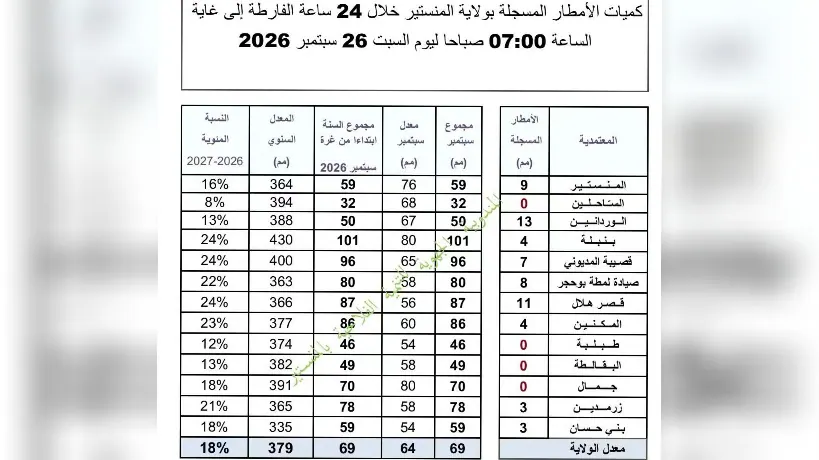
Over the past 24 hours, various regions in Tunisia's Monastir Governorate experienced moderate to heavy rainfall, according to a report by the Regional Agricultural Development Commission in Monastir, under the Ministry of Agriculture, Water Resources, and Maritime Fishing. The highest recorded rainfall was 13 mm in the delegation of Werdanine, followed by 11 mm in Qasr Hilal, 9 mm in Monastir City, and 8 mm in Sayada Lmata Bouhajar.
The rainfall amounts recorded in other areas include 7 mm in Qasayba Al-Midun, 4 mm in both Benblane and Al-Makinine, and 3 mm in Zarmedin and Bin Hassan. However, no new rainfall was recorded in the delegations of Al-Sakhalin, Al-Tablaba, Al-Bqalita, and Jamal during the same period. These recent rainfall amounts have contributed significantly to the accumulated totals since the beginning of September.
According to data on accumulated rainfall since the start of September, the delegation of Benblane leads with 101 mm, exceeding the normal monthly average of 80 mm. Qasayba Al-Midun follows with 96 mm, then Qasr Hilal with 87 mm, and Al-Makinine with 86 mm. The average rainfall across Monastir Governorate since September 1st stands at approximately 69 mm, surpassing the normal monthly average for September, which is 64 mm.
This rainfall is particularly significant for the agricultural sector, as it helps improve soil water reserves, supports crops, and prepares better conditions for the launch of the new agricultural season. This is especially crucial after periods of fluctuating rainfall and increased demand for water resources. The distribution and continuity of these rainfall amounts over the coming weeks and months will be essential in supporting water resources and improving agricultural activity conditions.
Comparing the rainfall recorded since the beginning of September to the annual average, the delegations of Benblane, Qasayba Al-Midun, and Qasr Hilal have the highest percentages, at around 24% of their annual averages. Al-Makinine follows with 23%, and Sayada Lmata Bouhajar with 22%. These indicators suggest a positive start to the rainy season in several areas of Monastir Governorate.
The recent rainfall brings hope to farmers for a better agricultural season, especially if it continues regularly and balanced over the coming period. The Regional Agricultural Development Commission in Monastir will likely continue to monitor the situation closely, providing updates on the impact of these rainfall amounts on the agricultural sector.
The Tunisian Ministry of Agriculture, Water Resources, and Maritime Fishing will likely take note of these developments, considering the implications for the country's agricultural production and food security. As the situation evolves, further updates on the agricultural season and its prospects are expected.
Key points
- The recent rainfall in Monastir Governorate has exceeded the normal monthly average for September, bringing hope for a better agricultural season.
- The delegations of Benblane, Qasayba Al-Midun, and Qasr Hilal have recorded the highest rainfall amounts since the beginning of September.
- The continuity and distribution of rainfall over the coming weeks and months will be crucial in supporting water resources and improving agricultural activity conditions.