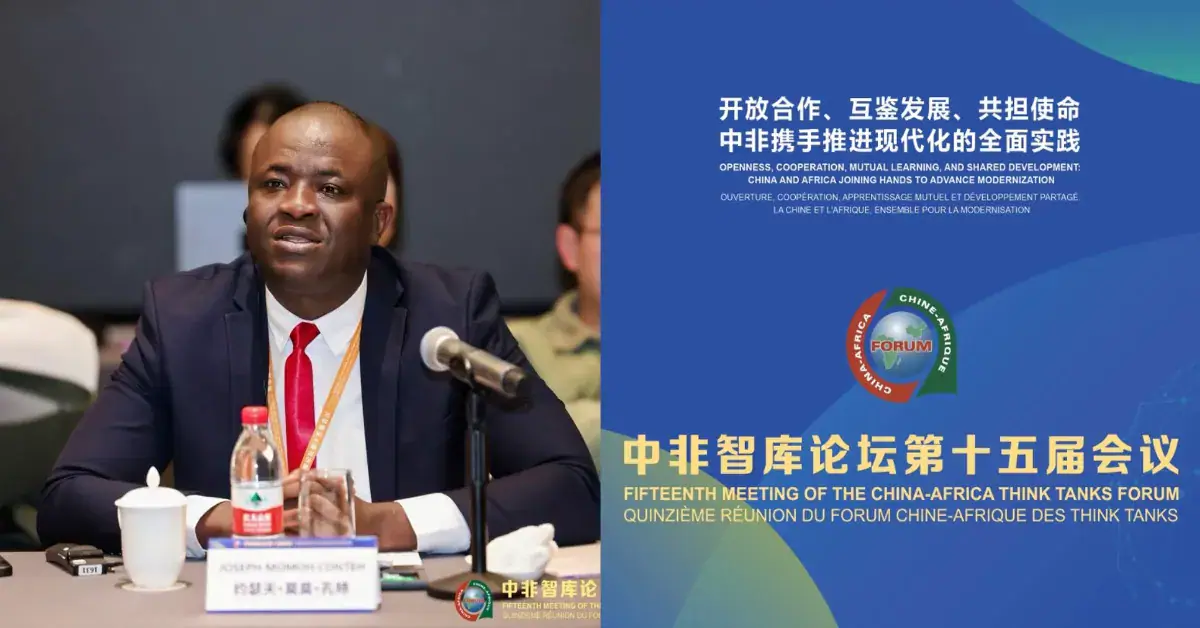
A Sierra Leonean PhD scholar at Peking University, Joseph Momoh Conteh, recently attended the 15th China-Africa Think Tanks Forum in Yiwu, China. The forum brought together African and Chinese researchers, officials, and development thinkers to discuss their continent's future. Conteh presented a paper on strengthening solidarity and cooperation among Global South countries and promoting reform of the global governance system. This was an opportunity for him to test his ideas against colleagues' experiences.
Conteh's presentation focused on why the Global South must work together. He argued that the rules governing finance, trade, and security were drafted when China and most of Africa were absent from the table. As a result, Africa has limited influence in international organizations, including the United Nations, where it holds no permanent seat on the Security Council. For Sierra Leone, this has practical consequences, such as a small economy setting its budget against interest rates and tariff rules it did not write.
The scholar emphasized that solidarity among Global South countries rests on four foundations. These include joint diplomacy to give small states a louder voice in international organizations, economic cooperation that creates jobs through processing and manufacturing at home, strong institutions that can negotiate, tax, and enforce contracts, and transparent delivery that allows citizens to see what a project cost and produced. Conteh also stressed that solidarity must respect differences between countries, such as Nigeria and Botswana, which have different priorities.
China plays a significant role in cooperation and shared development with Africa. Chinese finance and contractors have built infrastructure, such as roads, bridges, and power plants, that people use daily. Chinese firms also trade, invest, and employ, and have brought machinery, digital systems, and processing equipment to Africa. University partnerships link research institutions in both regions, and scholarships and training have placed African professionals in Chinese universities. Medical teams, laboratories, and vaccines have also been provided to Africa during health crises.
The relationship between China and Africa predates China's rise, with diplomatic ties beginning in 1971. China can teach Africa about planning over decades, testing policies before national rollout, and spending early on power and transport. Africa can also share its expertise with China, particularly in agriculture, informal enterprise, and diversity management. However, every African government must set its own priorities and bargain over terms, local content, and jobs.
Judicial cooperation and cross-border rule of law are essential in the China-Africa relationship. The FOCAC Beijing Action Plan for 2025 to 2027 commits both sides to judicial, law enforcement, and legislative exchanges. This includes accelerating work on extradition and criminal judicial assistance treaties. Practical work covers exchanges between courts, mutual legal assistance in civil and criminal matters, and cooperation against corruption, cybercrime, and trafficking.
Modernization through China-Africa relations involves more than just infrastructure development. It also means children who learn, clinics with medicine, industries that employ, and science applied to farming. China-Africa cooperation touches each of these areas through infrastructure, industrial development, skills training, research, technology, and exchange of experience. However, African countries must define their own modernization agenda, starting with their current needs and capacities.
Key points
- The 15th China-Africa Think Tanks Forum brought together African and Chinese researchers to discuss their continent's future.
- Sierra Leonean PhD scholar Joseph Momoh Conteh presented a paper on strengthening solidarity and cooperation among Global South countries.
- China-Africa cooperation involves infrastructure development, industrial development, skills training, research, technology, and exchange of experience.