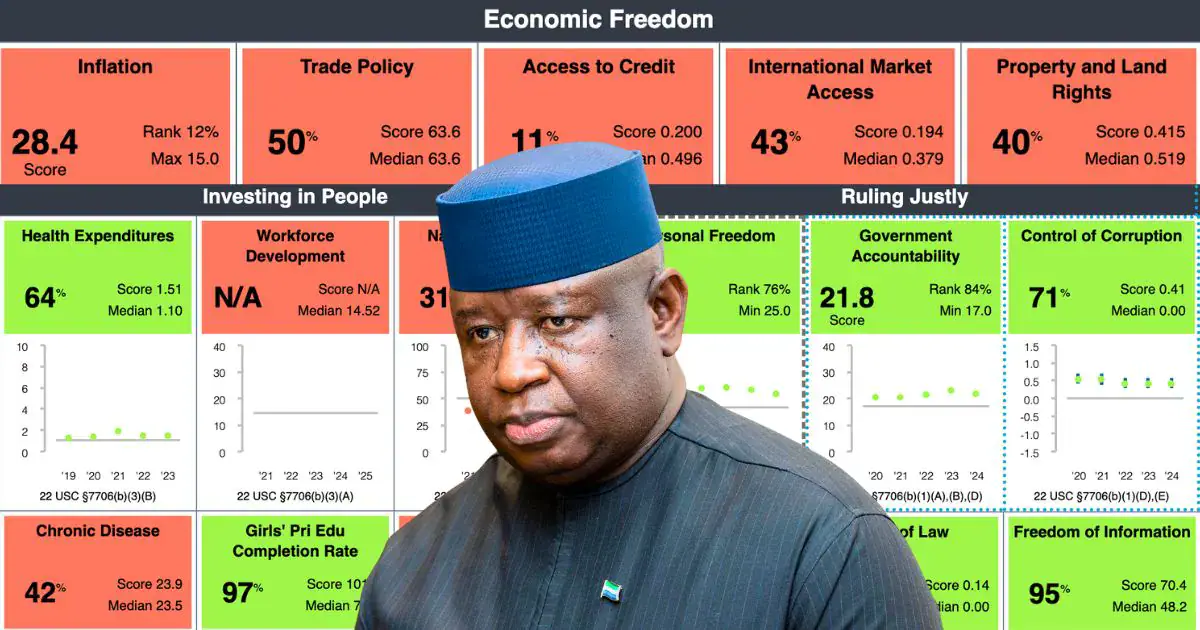
Sierra Leone has made significant strides on the Millennium Challenge Corporation's (MCC) FY2027 scorecard, meeting 11 of 22 indicators. This marks an improvement from the previous year, when the country satisfied nine indicators. The MCC scorecard assesses countries based on various parameters, including governance, economic freedom, and investment in people. Sierra Leone's progress reflects the government's efforts to strengthen governance, stabilize the economy, and improve the investment climate under President Julius Maada Bio's leadership.
The MCC expanded its scorecard from 20 to 22 indicators for FY2027, introducing new measures across economic freedom, investment in people, and governance. Sierra Leone's improved overall results demonstrate significant progress under this revised framework. Two notable achievements include a substantial drop in inflation from over 28% to 7.6% and successful passage of the newly introduced measure for business registration and the wider business environment. These gains indicate a more favorable business climate in the country.
Sierra Leone performed well in governance, passing five out of six "Ruling Justly" indicators. These include Personal Freedom, Government Accountability, Control of Corruption, Rule of Law, and Freedom of Information. The country's strong performance in these areas suggests a positive trend in governance and the protection of individual rights. The government's efforts to promote transparency and accountability have contributed to this progress.
The country also achieved impressive rankings in education and inclusion. Sierra Leone ranked at the 97th percentile for Girls' Primary Education Completion and the 88th percentile for Women in the Economy among countries in its income group. These results indicate significant progress in promoting girls' education and women's economic empowerment. The government's initiatives to improve access to education and economic opportunities for women have yielded positive outcomes.
Despite these achievements, the government acknowledged areas requiring further action and progress. These include health, natural resource protection, access to credit, and employment opportunities. The government will use the MCC scorecard findings to guide future reforms and turn progress into better services, jobs, and opportunities for citizens. This will involve addressing the remaining challenges and implementing policies to promote sustainable development.
The Sierra Leone government expressed gratitude to the MCC and the United States for their continued partnership. Joint initiatives, such as the implementation of the $494 million Energy Compact aimed at delivering more reliable electricity, demonstrate the strong collaboration between the two parties. The government values this partnership and will continue to work with the MCC to promote economic growth and development.
Looking ahead, the government will focus on sustaining and building on the progress made. Workforce Development was left unscored due to unavailable country data for this assessment cycle. However, the MCC confirmed that information received after data finalization shows Sierra Leone passes Health Expenditures. The government's commitment to addressing the remaining challenges and promoting sustainable development will be crucial in achieving long-term economic growth and improving the lives of its citizens.
Key points
- Sierra Leone passes 11 of 22 MCC indicators, up from 9 last year.
- The country achieves significant gains in governance, economy, and investment climate.
- The government will use MCC scorecard findings to guide future reforms and promote sustainable development.