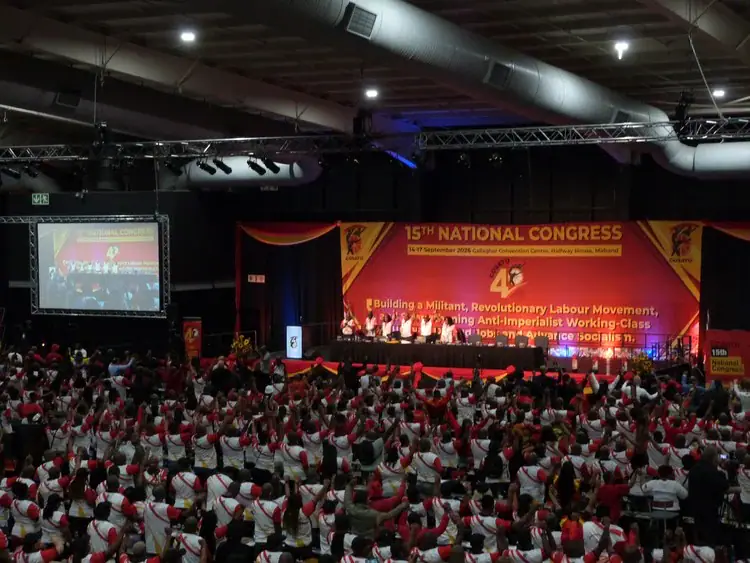
The South African trade union landscape is experiencing significant changes, with a fierce power struggle in the National Union of Metalworkers of SA (NUMSA) and the collapse of the Congress of South African Trade Unions (COSATU) National Congress. A rival faction in NUMSA has suspended general secretary Irvin Jim and other office bearers, citing a need for a national congress from 30 November to 4 December. Jim has declared his suspension invalid.
The changes in South Africa's trade unions reflect the country's shifting economic and political landscape. COSATU, which emerged in the 1980s, initially had a strong presence in the mining, manufacturing, and metal industries. However, over time, the centre of gravity of organised labour has shifted towards the public sector. Today, roughly 60% of COSATU members are concentrated in the public sector, leading to direct conflict with the government and tensions within the ANC-COSATU-SA Communist Party (SACP) alliance.
The 2012 Marikana massacre, in which police killed 34 striking mineworkers at Lonmin's Marikana mine, brought tensions within the alliance to a head. The incident posed questions about the relationship between the state, employers, and organised labour. COSATU's leadership and affiliates have since differed over how forcefully the federation should challenge the ANC and whether it should continue supporting the party at the ballot box.
The disagreements within COSATU culminated in an organisational crisis in 2014. NUMSA, one of COSATU's biggest unions, called for a special national congress to debate the federation's political direction. COSATU's leadership rejected NUMSA's position, leading to NUMSA's expulsion in November 2014. NUMSA argued that the expulsion was politically motivated, while COSATU cited NUMSA's conduct.
The departure of NUMSA, FAWU, and smaller unions reshaped the federation and broader labour movement. A new federation, the SA Federation of Trade Unions (SAFTU), was formed in 2017, with Zwelinzima Vavi as general secretary. SAFTU positioned itself as an independent, socialist federation, not aligned with the ANC or the SACP. It opposed privatisation, austerity measures, and changes to labour laws that it believed would weaken workers' rights.
By 2022, COSATU affiliates accounted for only 38% of registered union membership. Despite this, COSATU remains the largest federation, with about 1.4-million members. SAFTU has around 506,000 members, while the Federation of Unions of South Africa (FEDUSA) has 604,000 members and the National Council of Trade Unions (NACTU) has 394,000 members.
Today, COSATU has 16 active affiliates, with the two largest unions being public sector affiliates, the National Education, Health and Allied Workers' Union (NEHAWU) and the SA Democratic Teachers' Union (SADTU). SAFTU's largest affiliate in the public sector, the National Union of Public Service and Allied Workers (NUPSAW), has around 60,000 members. FEDUSA, formed in 1997, has maintained a stable base, claiming 617,000 members across 21 affiliates.
Key points
- COSATU's membership has shifted towards the public sector, with roughly 60% of members now concentrated in this sector.
- The power struggle in NUMSA and the collapse of COSATU's National Congress reflect the significant changes underway in South Africa's trade union landscape.
- SAFTU, formed in 2017, has positioned itself as an independent, socialist federation, not aligned with the ANC or the SACP.
Reporting sources
- Splits and shifts: the changing face of SA’s unions · EBNewsDaily