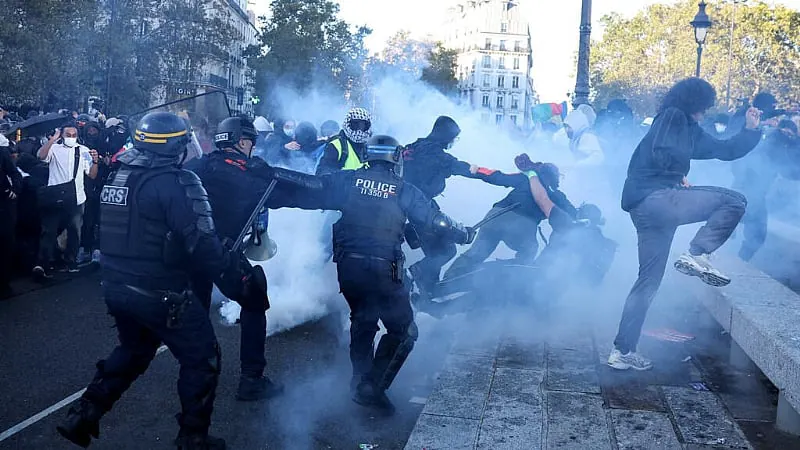
Student protests in France have resulted in severe injuries, drawing scrutiny to police tactics. A 14-year-old boy, Eden, suffered a broken jaw and multiple smashed teeth when hit by a tear gas canister during a protest in Saint-Ouen-l'Aumone. His lawyer, Elsa Marcel, stated that an officer approached him and struck him with a baton, prompting Eden to respond with a kick, and then a second officer fired a tear gas grenade, hitting him in the face.
The incident has sparked outrage, with Eden's family filing a complaint for attempted murder. The police officer involved was placed under formal investigation on charges of assault by a public official resulting in permanent disability or disfigurement. This case is one of 24 under investigation by the IGPN internal police watchdog linked to the policing of a more than two-week-long wave of student unrest over conditions in schools.
The protests have been marked by violence, with authorities reporting 700 police officers injured, schools burned or ransacked, and teachers and members of the public attacked. The police have arrested 6,877 people, mostly minors. Prime Minister Sébastien Lecornu described the demonstrations as the most violent in decades. The police response has renewed calls for the withdrawal of the use of rubber bullets and grenade launchers.
Human rights advocates, including Amnesty International, and some politicians have called for 'less lethal' weapons to be banned permanently. France stands out in Europe for its use of such weapons, which have caused fewer injuries in other countries. Researcher Sebastian Roche stated that France is an anomaly in terms of its use of arms and the number of victims, with four irreversible injuries in 12 days, all of whom are minors.
The interior ministry reported that about 200 students had been injured, but claimed it was rarely the result of police action. However, via interviews and reviews of legal documents, Reuters has documented 28 cases of injuries suffered due to police force, of which 15 are under investigation by the IGPN. In two cases, a person's eye has been lost or injured due to rubber bullets.
Police unions argue that the police need 'less lethal' weapons to enforce order in violent situations and ensure their own security. Thierry Clair, a police union representative, stated that serious injuries should not call into question France's policing techniques, but rather the intensity of the violence being committed by some young people. Mayor Bally Bagayoko of the left-wing France Unbowed party called for the withdrawal of rubber bullets to de-escalate tensions.
The protests show few signs of ending, with students vowing to continue demonstrating over conditions in schools. The interior ministry did not respond to questions on the cases of Eden and the 16-year-old student who was shot by police, injuring his left eye. The incidents have sparked anger among the public and fanned support for a protest movement that is the latest manifestation of deep-seated discontent with President Emmanuel Macron's government ahead of a 2027 election.
Key points
- Police face criticism over use of 'less lethal' weapons during student protests
- 200 students injured, mostly not due to police action, according to interior ministry
- Calls for ban on 'less lethal' weapons, such as rubber bullets and stun grenades