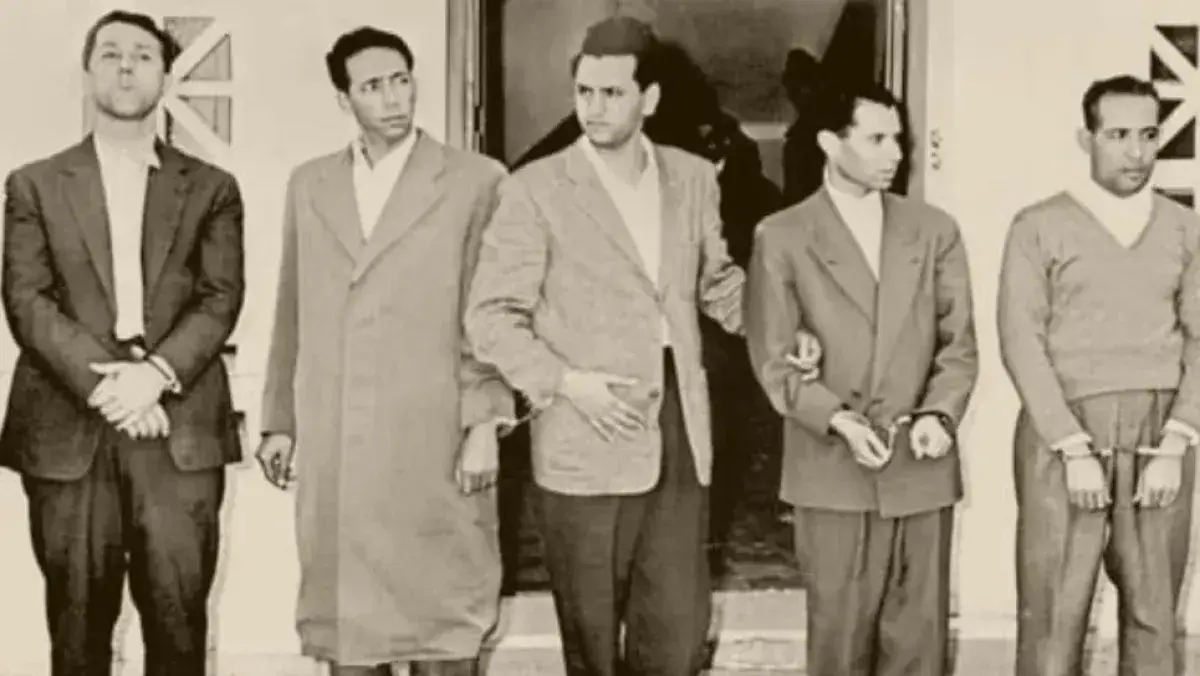
On the seventieth anniversary of the abduction of five Algerian revolutionary leaders on October 22, 1956, Algerian newspaper El Khabar opened the historical file by interviewing Professor Sufian Lousif. This event was one of the most significant political and diplomatic milestones in the country's liberation struggle. The abduction targeted five prominent national movement symbols as they traveled from Rabat to Tunis to participate in a Maghrebi meeting scheduled for October 23, 1956.
The discussion covered the historical and political context preceding the operation, the backgrounds of the Moroccan plane interception, and the French objectives behind the operation. The incident affected not only the arrest of the five leaders but also the Maghrebi relations and the Algerian cause on the international stage. The abduction occurred as the Algerian revolution was gaining strength and recognition, both domestically and internationally. By 1956, the revolution had become a well-organized national force, achieving military and political successes while increasing its diplomatic presence.
Internally, the revolution witnessed decisive developments in 1955 and 1956. The August 20, 1955, Constantine region attacks contributed to expanding the conflict and highlighting the revolution's popular character. The Soumam Conference on August 20, 1956, established new organizational, political, and military foundations, producing leadership institutions aimed at unifying revolutionary efforts and enhancing effectiveness. Despite some differences between internal and external leadership on command methods and political action, the revolution had made significant progress in building a sustainable organization capable of withstanding colonial pressures.
The Maghrebi meeting scheduled for October 23, 1956, held significant political and diplomatic importance. It aimed to transition Maghrebi solidarity with the Algerian revolution from popular support and official positions to joint diplomatic coordination. The meeting sought to revive the Maghrebi unity project historically linked to the region's peoples' struggle against colonialism. For the National Liberation Front, participation provided an opportunity to consolidate its political legitimacy as the actual representative of the Algerian cause.
The planning for intercepting the plane involved French intelligence tracking the external delegation's movements. French authorities sought to weaken the revolution's political leadership and hinder its diplomatic activity. The change in travel arrangements for the Algerian delegation was crucial in executing the operation. A Moroccan plane, a Douglas DC-3, was allocated to them, with a French crew. The flight route passed through the Spanish island of Mallorca before heading to Tunis, avoiding Algerian airspace under French control.
The abduction of the five leaders had a significant impact on the Algerian revolution's leadership. The arrested leaders, Ahmed Ben Bella, Mohammed Boudiaf, Mohammed Khider, Houari Ait Ahmed, and Mostefa Ashraf, played crucial roles in the external activity of the National Liberation Front. Their detention constituted a political and organizational blow to the front. The incident also highlighted the complexities of responsibilities within the French power structure, particularly regarding the level of prior knowledge of Prime Minister Guy Mollet.
The event remains a topic of historical discussion, particularly regarding the extent of prior knowledge among French authorities and the involvement of intelligence and military circles. The abduction of the five leaders marked a pivotal moment in the Algerian struggle for independence, influencing both the country's internal dynamics and its international relations. The incident serves as a reminder of the intricate and often contentious nature of historical events and their lasting impact on national and regional politics.
Key points
- The abduction of the five Algerian revolutionary leaders on October 22, 1956, was a pivotal event in the country's struggle for independence.
- The incident had significant implications for the leadership of the National Liberation Front and the international standing of the Algerian cause.
- The event continues to be a subject of historical debate, particularly regarding the level of prior knowledge and involvement of French authorities.