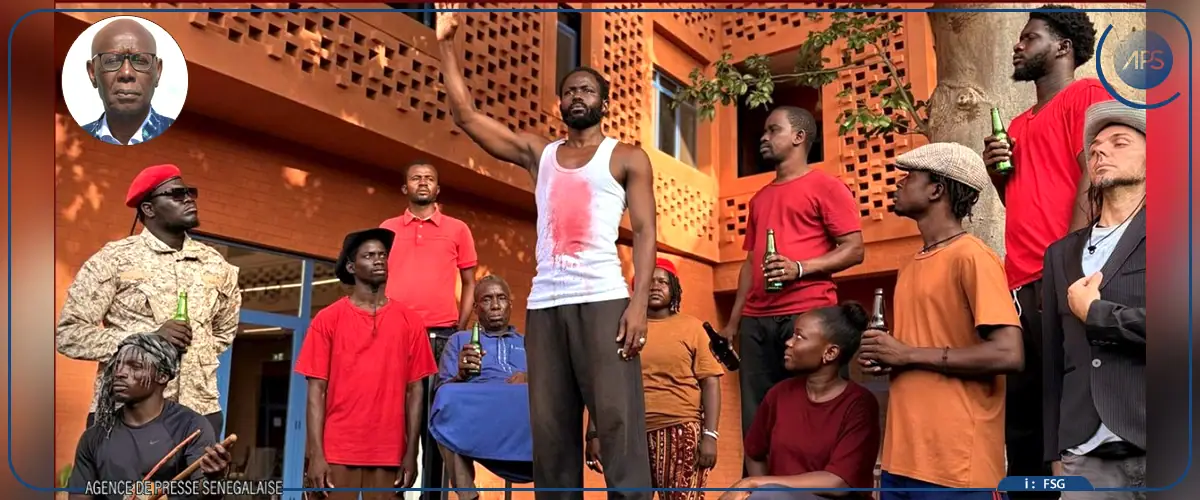
A theater piece titled 'Nawetu deret', written in Wolof by Senegalese writer Boubacar Boris Diop, was performed at the Goethe-Institut in Dakar. The play is an adaptation of Aimé Césaire's 1966 work, 'Une saison au Congo'. The performance, which lasted around an hour, was part of a closing artistic evening for an international and interdisciplinary colloquium dedicated to Boubacar Boris Diop. The event marked the 80th anniversary of the writer and explored the theme 'Boubacar Boris Diop: the charge and paths of writing'.
The play was performed by a troupe mostly composed of Senegalese comedians, allowing the audience to rediscover a major work of African political theater in a familiar language. The piece focuses on the tragic fate of Patrice Lumumba, the first Prime Minister of independent Congo, who was assassinated on January 17, 1961. The performance alternated between humorous sequences, satirical scenes, and tense passages, giving the historical narrative a diverting and reflective dimension.
Traditional Senegalese songs and dance were incorporated into the performance, enriching the interpretation and bringing the Congolese history closer to the audience's cultural universe. The set design transformed the stage into an open-air bistro, creating a space for encounter between the people and African elite. According to director Madiaw Ndiaye, the interest of this work lies in its ability to question the relationships of African leaders to power, beyond the historical context.
The play highlights the political rivalries and contradictions that marked the early years of independent Congo, in a context of strong foreign interference. Madiaw Ndiaye emphasizes the tragic nature of Lumumba's story, who was assassinated by his own people. He believes that the text continues to resonate with contemporary realities on the continent, particularly with power conflicts and political violence that fragilize African states.
Boubacar Boris Diop's adaptation is distinguished by the integration of Wolof cultural references, which bring the story closer to the Senegalese audience. Madiaw Ndiaye considers it a beautiful adaptation, not just a translation, but a work of reappropriation that gives the text a particular resonance in the Senegalese cultural environment. However, the staging required significant work on language, as some comedians were not accustomed to performing in Wolof.
The director chose to have certain characters played in duplicate, creating correspondences between 1960s Congo and contemporary Africa. The traditional Senegalese songs participate in this approach, giving a local color to a work whose stakes go beyond Congolese borders. Madiaw Ndiaye had to ensure fidelity to the writer's text while allowing artists to appropriate their roles, a process that took considerable time.
The performance is part of a larger celebration of Boubacar Boris Diop's work, which included an international colloquium and a series of artistic events. The event demonstrated the ongoing relevance of Césaire's work and its continued resonance with contemporary African issues. The play's success highlights the importance of theater in exploring and understanding the complexities of African history and culture.
Key points
- The play 'Nawetu deret' is an adaptation of Aimé Césaire's 1966 work 'Une saison au Congo', written in Wolof by Boubacar Boris Diop.