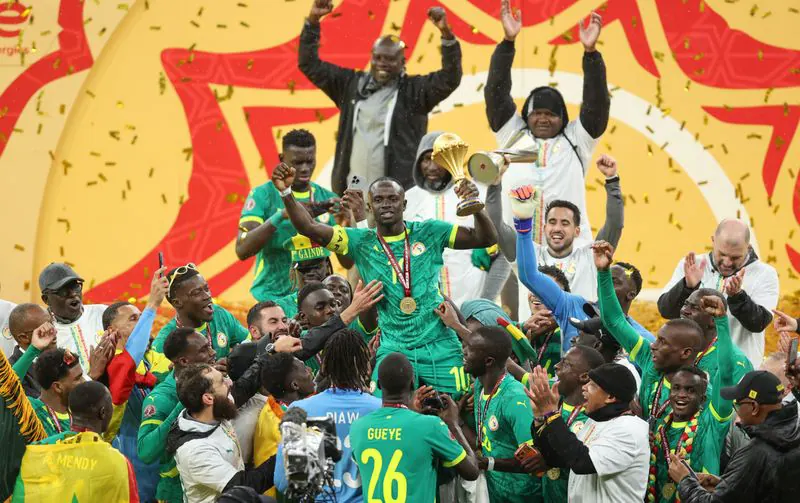
The Court of Arbitration for Sport (CAS) is set to hear Senegal's appeal on October 8 against the Confederation of African Football's (CAF) decision to strip them of the 2025 Africa Cup of Nations title. Senegal was crowned champions after defeating Morocco in the final on January 18 at Rabat's Prince Moulay Abdellah Stadium. However, CAF later retroactively handed the title to Morocco, citing Senegal's walkout during the match.
The walkout occurred due to some contentious officiating decisions, although Senegal eventually returned to the pitch and the match proceeded to its conclusion. CAF claimed that Senegal breached Article 82 of the Afcon regulations, which states that if a team refuses to play or leaves the field before the end of regulation time without the referee's authorization, they will be considered losers and eliminated from the competition. As a result, Article 84 was applied, stating that any team violating Article 82 will be permanently eliminated and lose the match 3-0.
The Senegalese Football Federation condemned CAF's decision as "unjust, unprecedented, and unacceptable," vowing to challenge the verdict at CAS. The outcome of the appeal hearing could have significant implications for soccer's integrity. If Senegal wins, it could reinforce the authority of referees' decisions on the pitch. Conversely, if CAS upholds CAF's decision, it may trigger a slippery slope of refereeing decisions being challenged retrospectively.
The referee for the match, Jean-Jacques Ndala from the Democratic Republic of Congo, allowed the game to continue to its conclusion despite Senegal's walkout. Morocco did not inform Ndala that they were playing the remainder of the match under protest and instead waited for the final outcome to lodge an appeal with CAF. CAF President Patrice Motsepe has stated that he will respect and implement the CAS decision, emphasizing that his personal opinion on the matter is irrelevant.
The Senegal vs Morocco saga is not an isolated incident that has dented soccer's integrity in 2026. The year has seen several high-profile off-field controversies, including the rescinding of a red card given to USA striker Folarin Balogun during the 2026 Fifa World Cup. Balogun's red card was inexplicably rescinded by Fifa, sparking widespread furor and allegations of external influence.
Fifa's decision to rescind Balogun's red card was defended by President Gianni Infantino, who claimed that the disciplinary committee's decision was not influenced by a phone call from US President Donald Trump. Infantino's attempt to invite external investors to bid for stakes in major tournaments sanctioned by Fifa also faced global pushback, ultimately forcing Fifa to backtrack on the plan.
The integrity of soccer has faced significant challenges in 2026, with several high-profile incidents raising concerns about the sport's governance. The outcome of the CAS hearing on October 8 will be closely watched, not only for its impact on Senegal and Morocco but also for its implications for the sport as a whole.
Key points
- The Court of Arbitration for Sport will hear Senegal's appeal against CAF's decision to strip them of the 2025 Africa Cup of Nations title.
- The appeal hearing could have significant implications for soccer's integrity and the authority of referees' decisions.
- The outcome of the hearing may influence the trajectory of future disputes and challenges in the sport.