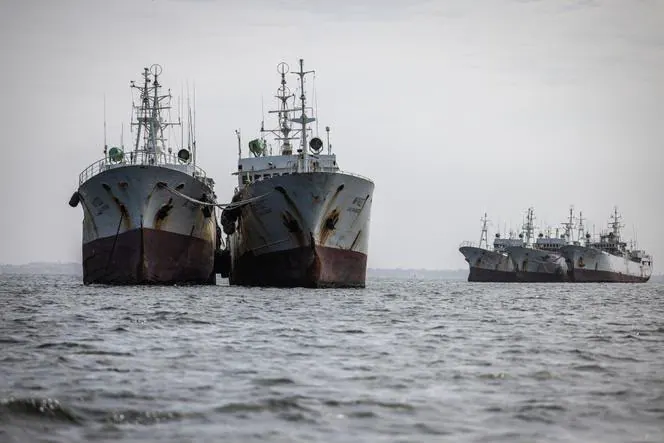
The Senegalese fishing industry has experienced significant growth in recent years, with nearly 100 new vessels registering under the country's flag between 2019 and 2024. According to a report by the Groupement des armateurs et industriels de la pêche au Sénégal (Gaipes), 101 new chalutiers were registered during this period, with 52 of them holding licenses in 2024. This surge in registrations has raised concerns about the sustainability of the country's fisheries resources and the level of foreign control in the industry.
The majority of the newly registered vessels have been licensed for deep-sea fishing, with 41 out of 52 licenses issued for this type of fishing. This represents a significant increase, with only two vessels holding such licenses before 2019. The rapid growth in the number of vessels licensed for deep-sea fishing has raised questions about the scientific basis for these new allocations. The Gaipes report notes that no studies by the Centre de recherches océanographiques de Dakar-Thiaroye (Crodt) have confirmed an increase in resources to justify this expansion.
The issue of foreign control in the Senegalese fishing industry has been highlighted by several organizations, including the Confédération africaine des organisations professionnelles de la pêche artisanale (Caopa) and the Conseil national interprofessionnel de la pêche artisanale au Sénégal (Conipas). They argue that the current system allows foreign interests to maintain effective control of vessels, often through complex ownership structures. Gaoussou Guèye, president of Caopa, cites the example of a company with a capital social of only 100,000 FCfa, yet associated with six chalutiers pélagiques côtiers worth several billion FCfa.
To address these concerns, the Caopa and Conipas are calling for reforms to the system governing mixed companies and fishing licenses. Their demands include greater transparency on real ownership, an audit of the fishing fleet, and respect for the opinions of artisanal fishermen. The organizations propose the creation of a national register of real owners and the publication of this information. They also suggest that an exhaustive audit of the Senegalese fleet should be conducted to assess the compliance of vessels with national flag access conditions and their contribution to food security, employment, and wealth creation.
The Senegalese fishing industry has faced significant challenges in recent years, with production declining sharply. According to data from the Agence nationale de la statistique et de la démographie (Ansd), the country's fish production fell from 510,545.98 tonnes in 2020 to 462,000 tonnes in 2021, and further to 435,000 tonnes in 2023. The Environmental Justice Foundation (Ejf) has highlighted the impact of mixed companies, often controlled by foreign interests, on the country's fisheries resources. In 2020, Ejf reported that 39 requests for new licenses had been submitted for chalutiers targeting merlu, a resource already considered overfished.
The issue of "senegalization" of vessels, where foreign interests maintain effective control despite being registered under the Senegalese flag, has been documented by several organizations, including Greenpeace. This phenomenon has raised concerns about the impact on the country's fishing industry and the livelihoods of artisanal fishermen. The authorities have been urged to take action to address these concerns and ensure the sustainability of the country's fisheries resources.
The Senegalese government has faced criticism for its handling of the fishing industry, with many calling for greater transparency and accountability. In response to these concerns, the government has published a list of vessels flying the Senegalese flag, a first since 2019. However, the Gaipes report and the concerns raised by various organizations highlight the need for further action to address the challenges facing the industry.
Key points
- The surge in new registrations and licenses for deep-sea fishing has raised concerns about the sustainability of Senegal's fisheries resources.
- Foreign control of vessels through complex ownership structures remains a significant issue in the Senegalese fishing industry.
- The industry faces significant challenges, including declining production and the need for greater transparency and accountability.