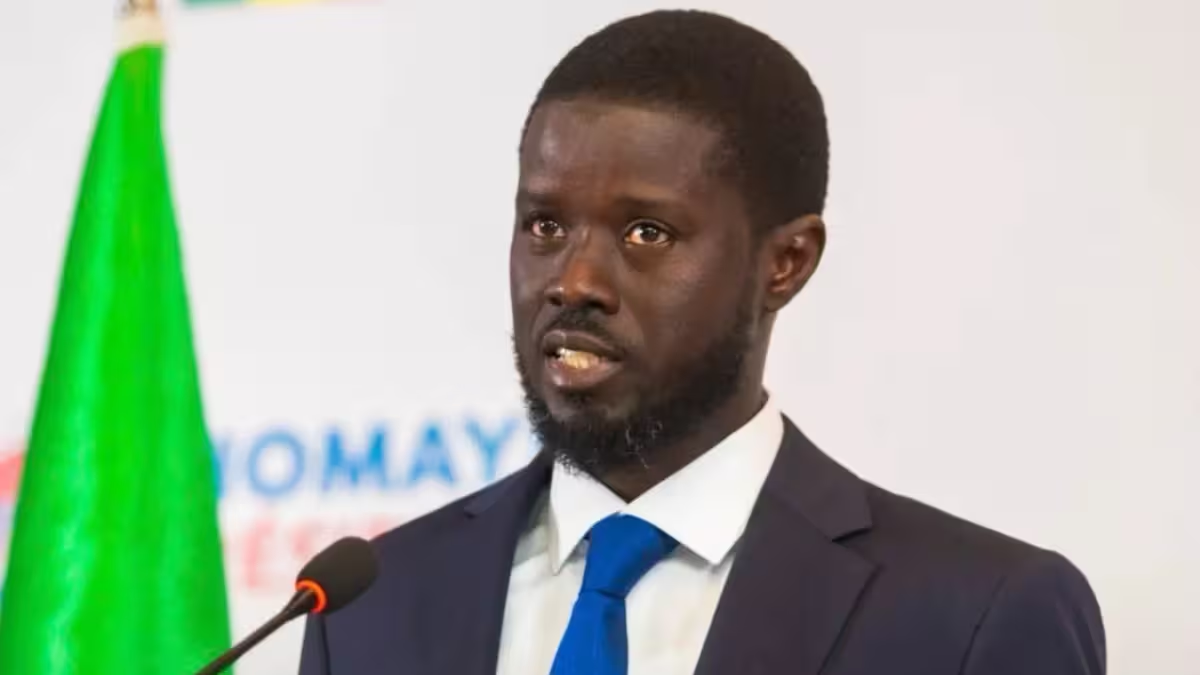
On September 24, at the United Nations General Assembly in New York, Senegal's President Diomaye Faye, who is also the current president of the Economic Community of West African States (ECOWAS), delivered a speech urging the international community not to abandon the Sahel region in its fight against terrorism. The Sahel has been the most affected region globally by extremist violence for three consecutive years. President Faye emphasized the need for a coordinated response among neighboring countries to address this growing threat.
President Faye situated the security issue within a broader context of a "crisis of trust" between states and towards multilateral institutions. He noted that this crisis is fueled by a permanent conflict that promotes an arms race and undermines disarmament mechanisms, while increasing the risks associated with new technologies. In this context, he reaffirmed Senegal's commitment to working with the African Union and the United Nations to promote peace in the sub-region.
The Senegalese president specifically highlighted the fight against terrorism, describing it as a common struggle that requires a transnational approach. He warned against isolating the Sahel region, which, if destabilized, would have far-reaching consequences not only for the rest of the African continent but also for other interests present in the region. President Faye's intervention aims to reposition ECOWAS as a key coordinator between different dynamics in the region.
According to the Global Terrorism Index, the Sahel's share of global terrorism-related deaths has increased significantly over the past two decades, from less than 1% in 2007 to over 50% today. This shift has made the region the epicenter of global terrorism, with Niger, Mali, and Syria being among the most affected countries. In 2025, Niger recorded 703 deaths, mostly civilians, making it the third most affected country globally.
On the ground, two approaches coexist without being formally linked. The Mali, Burkina Faso, and Niger have established a common security framework within their confederation, prioritizing security as a prerequisite for any other political ambition. In contrast, countries like Senegal and Côte d'Ivoire advocate for a broader mobilization, involving regional organizations and international partners. President Faye's speech at the UN aims to promote a coordinated response to the terrorism threat in the Sahel.
The Sahel region's security situation has significant implications for the entire African continent. The region's instability could have a ripple effect, impacting neighboring countries and the global community. President Faye's call for international support and coordination underscores the need for a collective response to address the complex security challenges facing the Sahel.
As the international community continues to grapple with the terrorism threat in the Sahel, President Faye's intervention at the UN serves as a reminder of the need for sustained support and coordination to address this pressing issue. The ECOWAS president's emphasis on collaboration and collective action highlights the importance of working together to promote peace and stability in the region.
Key points
- - The Sahel region has become the epicenter of global terrorism, accounting for over 50% of global terrorism-related deaths. - President Diomaye Faye urges the international community not to abandon the Sahel region in its fight against terrorism. - The Senegalese president emphasizes the need for a coordinated response among neighboring countries to address the growing threat of terrorism in the Sahel.