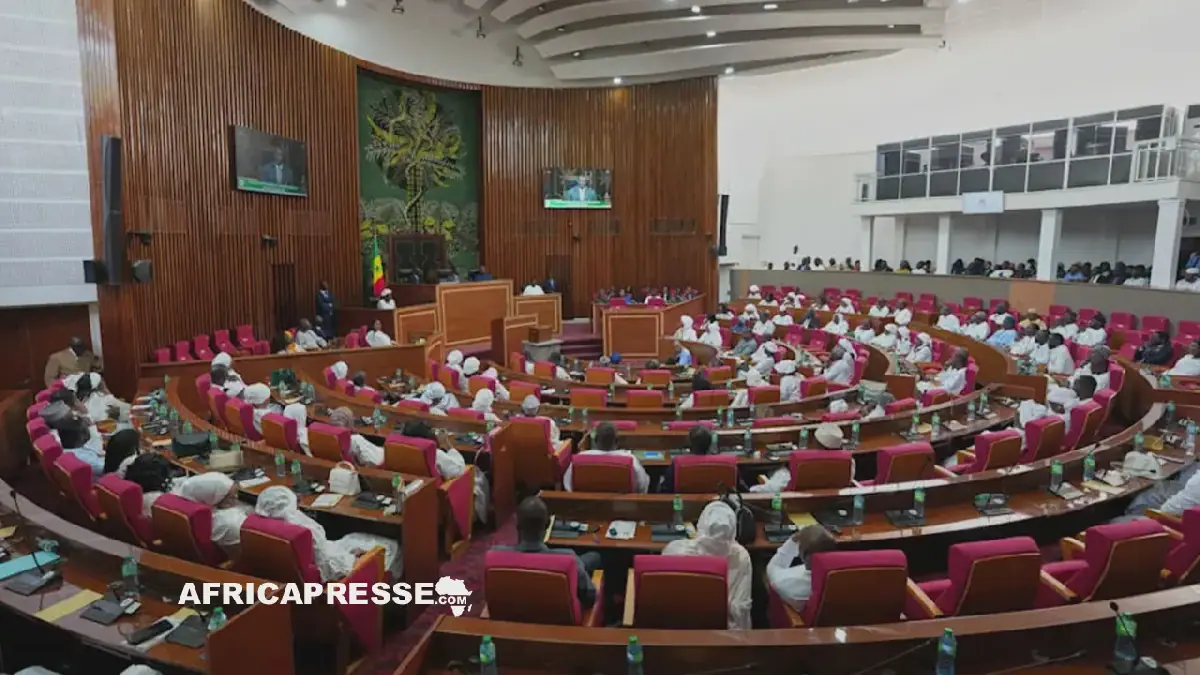
The Senegalese National Assembly, dominated by the Pastef party, has adopted a resolution against the adoption by decree of the 2026 rectified budget. The move is seen as a sign of tension between the parliament and the executive, amid negotiations with the International Monetary Fund (IMF). The resolution was adopted with 128 votes in favor, 9 against, and 2 abstentions. The deputies of the majority consider the text to be unconstitutional and illegal.
The resolution was adopted on November 25, following a meeting of the Council of Ministers the previous day, where President Bassirou Diomaye Faye ordered the implementation of the finance law "without delay". The Pastef party considers that the adoption of this budget by decree constitutes a serious violation of the legislative process, justifying the adoption of this resolution. The text recalls to the spending officers, budget controllers, public accountants, payers, and agents of the tax and customs administrations that their responsibility could be engaged in case of execution of the decree.
This crisis occurs in a context of deep division of the Senegalese political class. The opposition accuses the Pastef of taking the National Assembly hostage, as part of the arm-wrestling between its president and former Prime Minister Ousmane Sonko and the head of state Bassirou Diomaye Faye. On the economic level, the rectified finance law project is presented by the executive as a key measure to respond to the IMF's requests on public finance management, while the country's debt was estimated at 132% of GDP at the end of 2024.
The IMF announced in September a preliminary agreement with Senegal on a new aid program of 2.2 billion dollars over 36 months, but its administrative council has not yet approved the agreement. The parliamentary resolution, although not binding on the executive, could complicate these negotiations. The deputy Ayib Daffe, head of the Pastef parliamentary group, considers that the passage by force is "the worst means" of obtaining an IMF program.
The deputy Abdou Mbow, of the Takku Wallu group, considers the resolution to be useless and calls on the Pastef to go to court rather than vote on a symbolic text. He questions the legal value of the resolution, if it is not to sabotage the agreement that could be obtained with the IMF. He recalls that the majority has legal avenues to contest the decree before the Supreme Court or the Constitutional Council.
The head of the Pastef parliamentary group recognizes that his formation could go to court in a second time, but affirms that the immediate objective is to send a message to the executive and to the IMF. Beyond the budget, this sequence reveals a lasting fracture between the two heads of the executive and a parliamentary majority which intends to weigh on budgetary decisions.
The resolution, without being legally binding, creates a political precedent: it exposes the officials to risks of responsibility and fragilizes the position of Senegal in relation to its creditors. In a country seeking to restore investor confidence and stabilize its public finances, the outcome of this conflict could determine the government's ability to carry out its economic program.
Key points
- The Senegalese parliament's resolution against the executive's budget move could complicate negotiations with the IMF.
- The crisis reveals a deep division in the Senegalese political class.
- The resolution creates a political precedent, exposing officials to risks of responsibility.