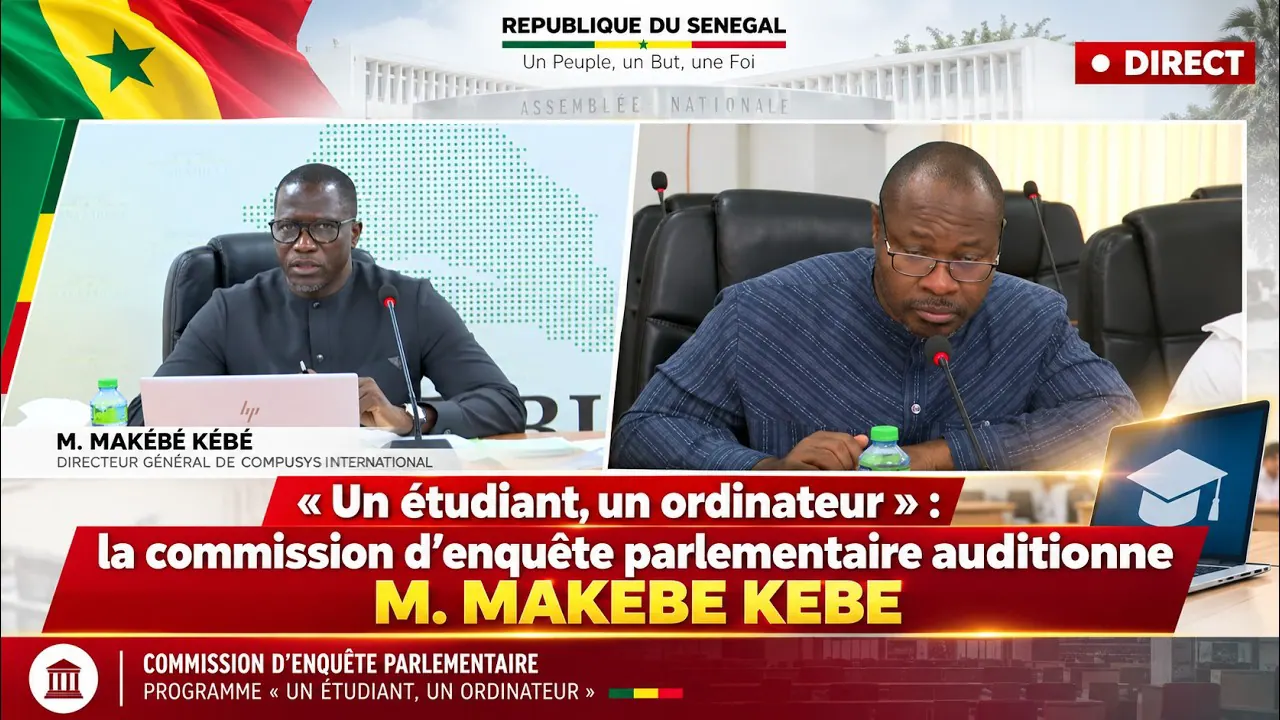
The Senegalese parliament's investigative commission heard testimony from Makébé KÉBÉ, director general of Compusys International, on October 9, 2026. KÉBÉ's company was contracted to supply computers to students at the University Cheikh Hamidou KANE for the 2025 academic year. However, he claimed that administrative dysfunctions led to thousands of machines being left idle at the Port autonome de Dakar. KÉBÉ stated that he repeatedly informed the directors of the Direction du financement des établissements d'enseignement supérieur (DFES) and the Direction générale de l'enseignement supérieur (DGES) about the arrival of the computers, but received no response.
According to KÉBÉ, the lack of response from the authorities led him to seek an audience with the Minister of Higher Education at the time, Daouda NGOM. The minister reportedly assured KÉBÉ that he would expedite the matter, but instead, the ministry announced a subsidy of 250,000 FCFA to students, rather than distributing the 5,000 computers. KÉBÉ emphasized that no contract termination notice was served to Compusys International. The company was left with a large stock of computers, incurring additional storage costs.
KÉBÉ distanced himself from any procedural irregularities, stating that he was not aware of any issues with the procurement process. He claimed that it was the responsibility of the authorities to regularize the procedure and notify the market. KÉBÉ stressed that his company's commitment was solely to fulfilling the terms of the contract, which included supplying the computers. The contract was awarded following an invitation to tender, which KÉBÉ believed was not suitable for a supply contract.
The investigative commission's hearings have uncovered several irregularities in the program. The Autorité de régulation de la commande publique (ARCP) had previously deemed the invitation to tender "particularly unsuitable" for a computer purchase. The ARCP's report stated that the contracts were null and void. Mame Penda BA, former director of financing for higher education institutions, had mentioned a planned order of 25,000 computers for the 2025-2026 academic year, including 5,000 from Compusys International.
The commission's hearings continue, having started on October 5, 2026. So far, the investigations have revealed a lack of administrative records for the program, the absence of a referral to the ministry's market procurement cell, and the misuse of an invitation to tender for a supply contract. The name of Compusys International was mentioned in the early hearings, along with that of another company, Computerland.
KÉBÉ's testimony also touched on the issue of the 250,000 FCFA subsidy awarded to students instead of the computers. He expressed surprise at the decision, which was announced without any notification of contract termination to his company. The subsidy decision has raised questions about the government's intentions and the management of public funds.
The controversy surrounding the "One Student, One Computer" program raises concerns about transparency and accountability in public procurement. The parliament's investigation aims to shed light on the irregularities and identify those responsible. The outcome of the investigation is expected to have implications for the future of public procurement in Senegal.
Key points
- The Senegalese parliament's investigation into the "One Student, One Computer" program has uncovered irregularities in the procurement process.
- The program's implementation was marred by administrative dysfunctions, leading to thousands of computers being left idle.
- The Autorité de régulation de la commande publique deemed the invitation to tender "particularly unsuitable" for a computer purchase.