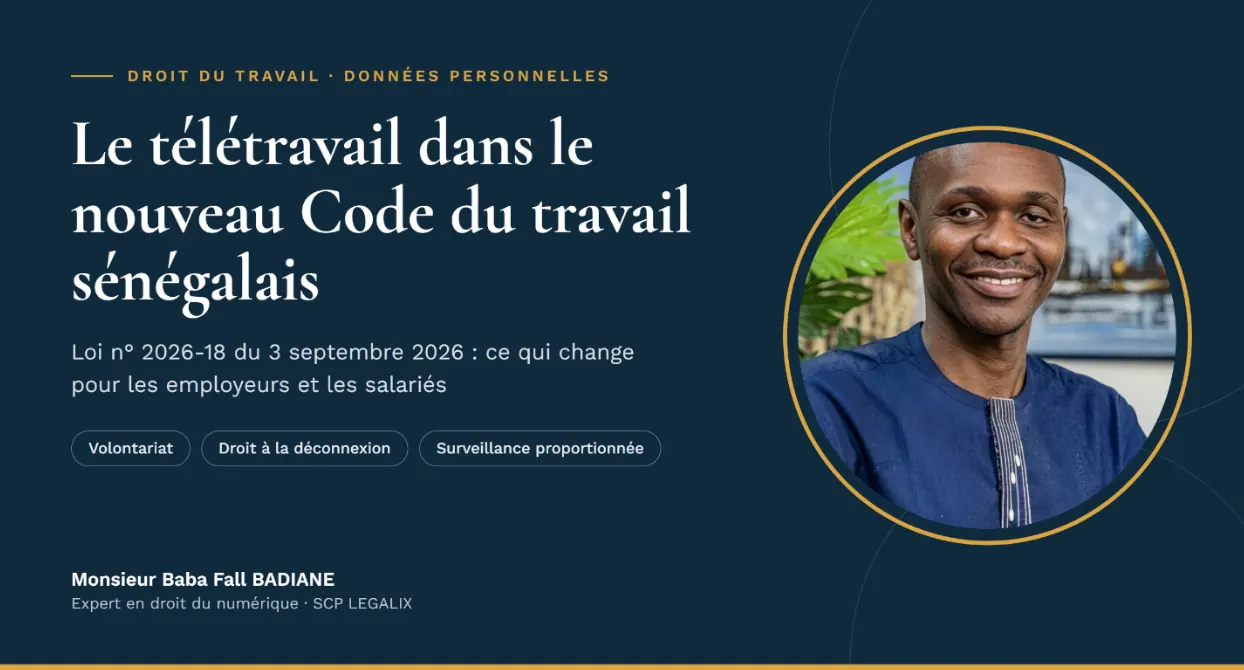
The new labor code in Senegal, law n° 2026-18, has introduced regulations for telework, marking a significant evolution in the country's labor laws. Telework is defined as a mode of work organization where tasks are performed outside the employer's premises, using information and communication technologies. This development aims to provide clarity and protection for both employers and employees engaging in remote work.
The code establishes a specific regime for telework, consisting of articles 268 to 273, supplemented by provisions related to health, safety, and personal data protection. The definition of telework has three key elements: the task must be executable in the employer's premises, its execution can be full or partial, and it relies on information and communication technologies. This legal recognition addresses concerns about work conditions, accident definitions, and data protection.
The new regulations are built on three pillars: mutual consent, maintenance of employee rights, and control mechanisms for personal data. The code emphasizes the importance of written agreements between employers and employees, outlining conditions for telework, including work locations, schedules, and equipment. This written consent is crucial for preventing future disputes and ensuring clear obligations for both parties.
In cases of exceptional circumstances, such as epidemics or pandemics, employers can implement telework unilaterally to ensure business continuity and worker protection. This exception allows employers to adapt work arrangements without prior employee consent or consultation with staff representatives. However, such measures must be justified by real circumstances and remain relevant to the situation.
The implementation of telework requires a collective and individual approach. Employers must consult with staff representatives and the safety and health committee before introducing telework. If no staff representatives exist, employers must consult with all employees or designate representatives. Individual agreements must be made in writing, detailing telework conditions, to prevent disputes and clarify responsibilities.
The new code provides a framework for telework, addressing concerns about employer control, data protection, and work conditions. By establishing clear guidelines, the Senegalese government aims to promote flexible work arrangements while protecting workers' rights. The regulations will likely have a significant impact on the country's labor market and work culture.
The introduction of telework regulations in Senegal's labor code reflects the country's efforts to adapt to changing work environments and technological advancements. As the world becomes increasingly digital, this development positions Senegal to better address the needs of employers and employees in the modern work era. The code's effectiveness will depend on its implementation and enforcement.
Key points
- The new labor code in Senegal introduces a legal framework for telework, emphasizing mutual consent, employee rights, and data protection.
- Telework arrangements in Senegal must be based on written agreements between employers and employees, outlining conditions and responsibilities.
- In exceptional circumstances, such as pandemics, employers can implement telework unilaterally to ensure business continuity and worker protection.