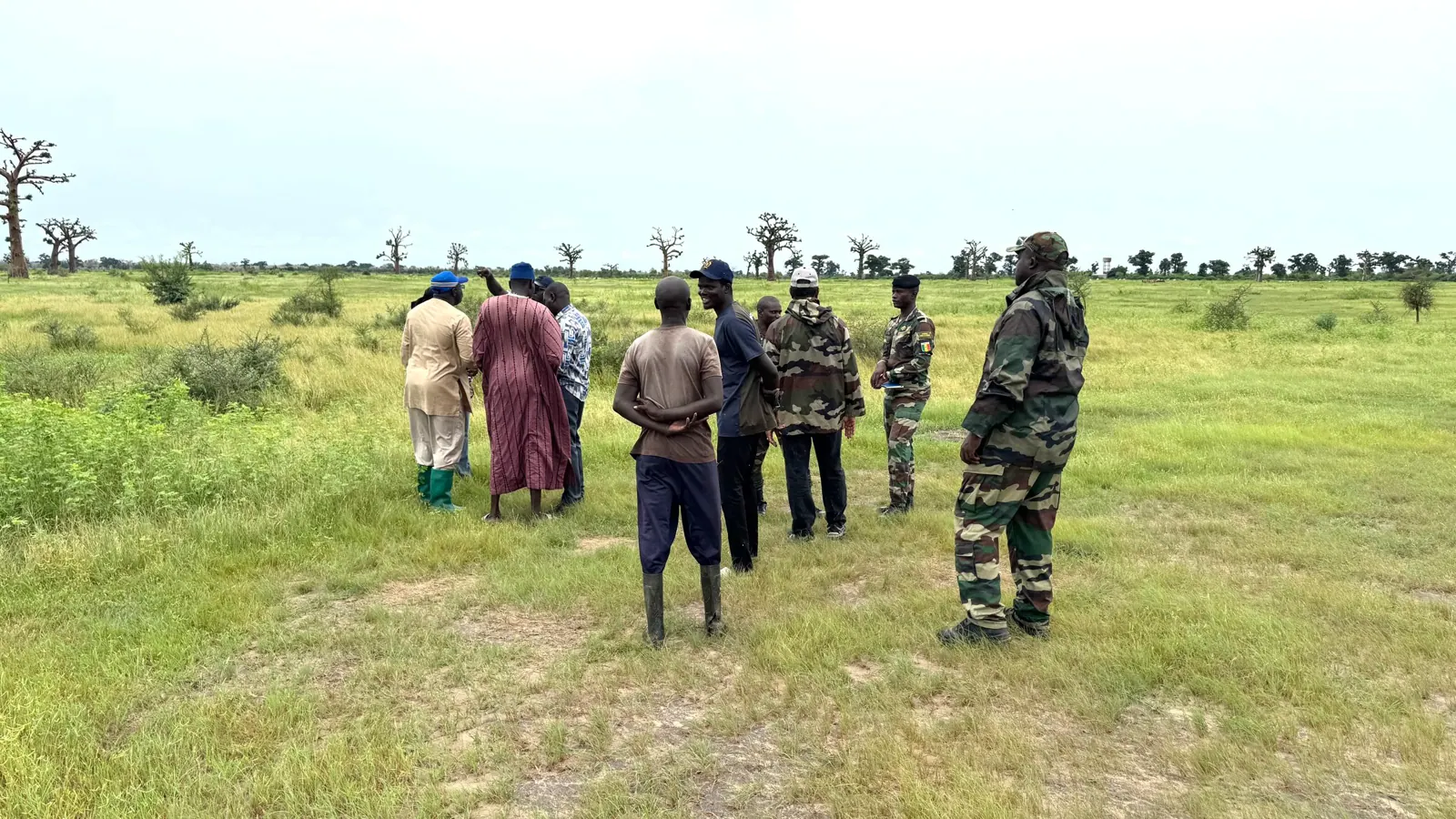
In Ndingler, a community in Senegal's Ndiaganiao commune, a new phase has begun in the long-standing land dispute. Following years of tension over 80 hectares of land, the focus has shifted to reviving the land and enabling the affected families to cultivate it effectively. A joint mission by the Ministry of Agriculture, Food Sovereignty, and Livestock (MASAE) and the Military Engineering Corps recently visited the site to assess the work required to restore the land.
The mission found that the land, which has lain idle for years, requires significant preparation, including clearing, stump removal, leveling, and soil decompaction. Securing the perimeter is a priority, with precise delimitation and marking of the 80 hectares and individual plots essential for technical teams to work on a clearly defined area and ensure the land is allocated to beneficiary families. This marks a significant shift in approach, following Babacar Ngom's voluntary renunciation of the land title in January 2026.
The Senegalese government aims to transform the land dispute resolution into economic and social benefits. This involves not only restoring the land to cultivation but also providing conditions for sustainable production. Access to water is a significant challenge, with plans to drill boreholes and establish a distribution system, subject to technical and hydrogeological studies. The goal is to reduce reliance on rainfall and promote more regular production.
Physical security of the perimeter is another identified need, with a fence potentially protecting the plots and investments. The involvement of the Military Engineering Corps, led by Colonel Biaye, brings a unique dimension to the operation, with a focus on evaluating mechanized means for heavy works. Multiple agencies, including the National Pedology Institute (INP) and the National Agency for Agricultural and Rural Advice (ANCAR), participated in the mission.
The diversity of challenges to be addressed is reflected in the range of participating agencies, including soil quality, access to plots, mechanization, water, perimeter protection, producer organization, and agricultural support. Simply restoring the land is not enough; the beneficiary families must be able to generate sustainable income from it. Traditional crops in the area include millet, peanuts, maize, and cowpeas.
The involvement of local communities is central to the initiative, with discussions focusing on compatible agricultural activities and the capacities of the families. The next step will be to develop a detailed plan, prioritizing areas, quantifying work, identifying necessary resources, and establishing a mobilization schedule. A phased approach is envisaged, starting with accessible and technically preparable sectors.
Ultimately, the success of the initiative will be measured by the actual cultivation of the land and the income generated for the 39 beneficiary families. The 80 hectares of land are no longer just a disputed area but represent a tangible opportunity for agricultural production and economic development in Ndingler.
Key points
- The Senegalese government has launched an initiative to restore 80 hectares of land in Ndingler to agricultural production, benefiting 39 families.
- The project involves a joint effort by the Ministry of Agriculture, Food Sovereignty, and Livestock (MASAE) and the Military Engineering Corps.
- The initiative aims to not only restore the land but also provide conditions for sustainable production, including access to water and physical security.