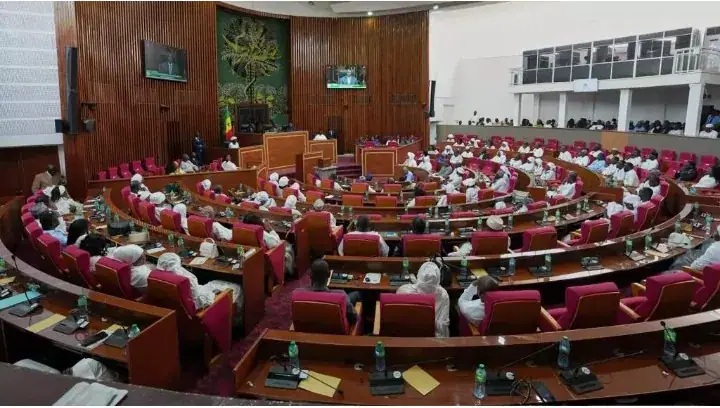
The Senegalese National Assembly, dominated by the Patriots of Africa for Work, Ethics, and Fraternity (Pastef), rejected the government's revised budget proposal on November 3, 2026. Despite a new review by the finance commission, the proposal failed to convince Pastef lawmakers. This development risks blocking a $2.2 billion loan from the International Monetary Fund. The rejection comes as a significant setback for the government, which urgently needs the revised budget to pay debts to private sector companies and electricity suppliers.
The revised budget proposal, which received 126 votes in favor, was sent back to the executive without a thorough debate. The rejection was based on a preliminary question proposed by Pastef lawmaker Amadou Ba. The opposition party argued that the 2026 corrected budget lacked budgetary sincerity and could not be adopted in its current form. Pastef lawmakers expressed concerns over discrepancies in revenue and expenditure forecasts in the revised budget proposal.
One of the key concerns raised by Pastef lawmakers was the estimated budget deficit of 7.6% of GDP, which they believed was overestimated. Additionally, they claimed to lack clarity and reliable information on debt sustainability, making it difficult for them to assess real financing needs and debate the proposal. In response, Finance Minister Cheikh Diba accused the Pastef party of using the rejection as a pretext to block the revised budget.
The rejection of the revised budget proposal marks a significant blow to the government, which had been counting on it to pay debts and ensure a stable electricity supply. The government's ability to service its debts and maintain essential public services is now at risk. The International Monetary Fund's loan, which was contingent on the adoption of the revised budget, is also in jeopardy.
The Pastef party's concerns over the budget proposal's transparency and accuracy reflect a deeper debate over Senegal's economic management. The party's leader, Ousmane Sonko, who is now the President of the National Assembly, has been critical of the government's economic policies. The rejection of the budget proposal is seen as a manifestation of the tensions between the government and the opposition.
The government's next steps are unclear, but it is expected to revisit the budget proposal and address the concerns raised by Pastef lawmakers. The revised budget proposal will need to be re-submitted to the National Assembly for approval. The government's ability to negotiate a new budget that meets the opposition's demands will be crucial in determining the country's economic trajectory.
The rejection of the revised budget proposal has significant implications for Senegal's economic future. The country's ability to secure funding from the International Monetary Fund and other international lenders will depend on its ability to demonstrate fiscal responsibility and transparency. The government's response to the opposition's concerns will be closely watched by investors and analysts.
Key points
- The Senegalese National Assembly rejected the government's revised budget proposal due to concerns over transparency and accuracy.
- The rejection risks blocking a $2.2 billion loan from the International Monetary Fund.
- The government's ability to service its debts and maintain essential public services is now at risk.