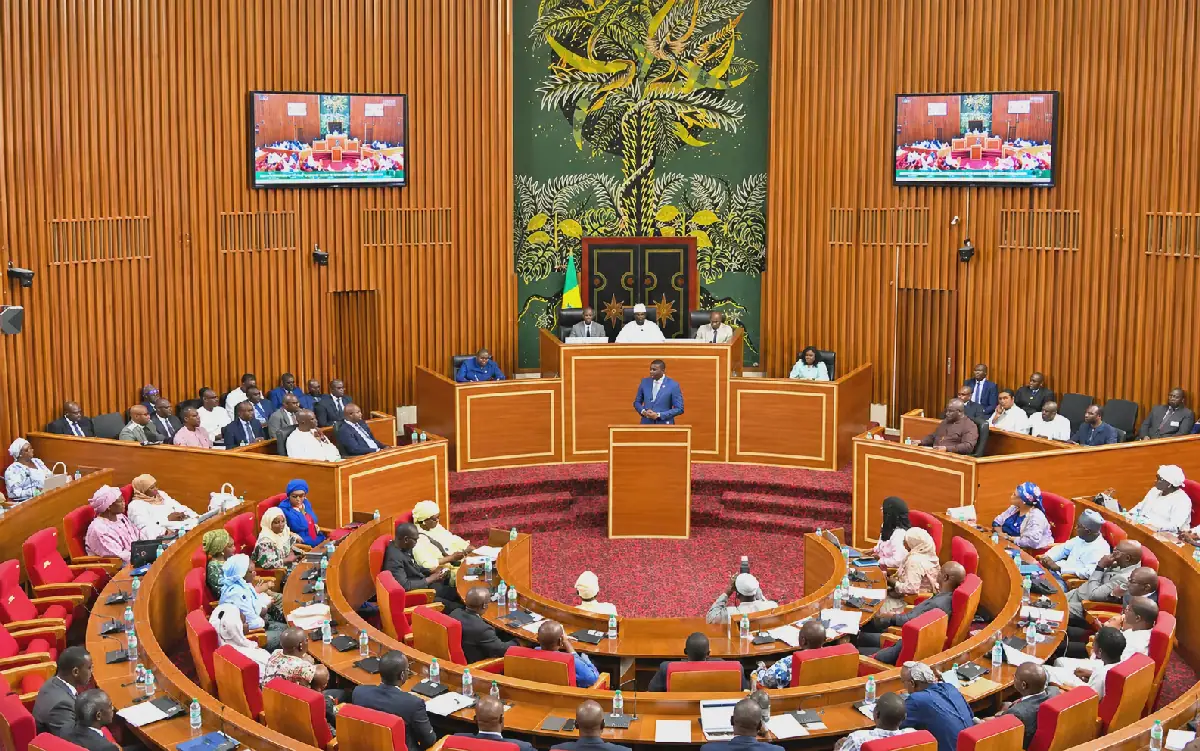
On November 3, 2026, the Senegalese National Assembly adopted a preliminary question presented by Deputy Amadou Ba, leading to the rejection of the government's 2026 supplementary finance bill. The bill, which aimed to adjust the country's budget, was not examined in-depth by lawmakers. A total of 132 out of 165 registered deputies participated in the vote, with 109 supporting the preliminary question, 20 opposing it, and 3 abstaining.
The preliminary question, provided for in Article 83 of the National Assembly's internal regulations, allows for the conclusion that there is no need to continue examining a text. Its adoption results in the rejection of the bill without a general debate. Deputy Amadou Ba justified his support for the preliminary question by expressing concerns about the government's budgetary forecasts, particularly the announced deficit of 7.6% of GDP and the planned execution of 644 billion FCFA in investments financed by external resources.
The Commission on Finance and Budgetary Control had previously expressed concerns about the bill, including questions about the deficit, reduction in public investments, PRES revenues, energy sector subsidies, and payment arrears. These concerns were echoed by Deputy Amadou Ba, who emphasized the need for an agreement with the International Monetary Fund (IMF). However, he did not challenge the necessity of reaching such an agreement.
In response to these criticisms, Minister of Economy, Finance, and Planning Cheikh Diba rejected the argument of budgetary sincerity presented by Deputy Amadou Ba. According to the minister, the real disagreements lie in the Economic and Social Recovery Plan (PRES), which deputies felt they had not received sufficient information on. Cheikh Diba accused his opponents of using the budgetary sincerity issue as a pretext to reject the bill.
The minister also questioned the accuracy of the Commission on Finance and Budgetary Control's report, presented by rapporteur general Mady Danfakha. He disputed the sections related to hospital projects in several cities, the special funds, and the amendments. According to Cheikh Diba, the government's responses to the commission's questions were sufficient, and no further modifications to the bill were justified.
The rejection of the 2026 supplementary finance bill highlights the persistent disagreements between the government and some parliamentarians on the country's economic and financial orientations. The bill's rejection may have implications for Senegal's economic recovery and its relations with international financial institutions, such as the IMF.
The National Assembly's decision will likely lead to a re-examination of the government's budgetary priorities and may require further negotiations with parliamentarians. The rejection of the bill also underscores the challenges facing the government in implementing its economic and social programs, particularly in the context of Senegal's economic recovery efforts.
Key points
- The Senegalese National Assembly rejected the 2026 supplementary finance bill due to concerns about budgetary forecasts and the Economic and Social Recovery Plan (PRES).