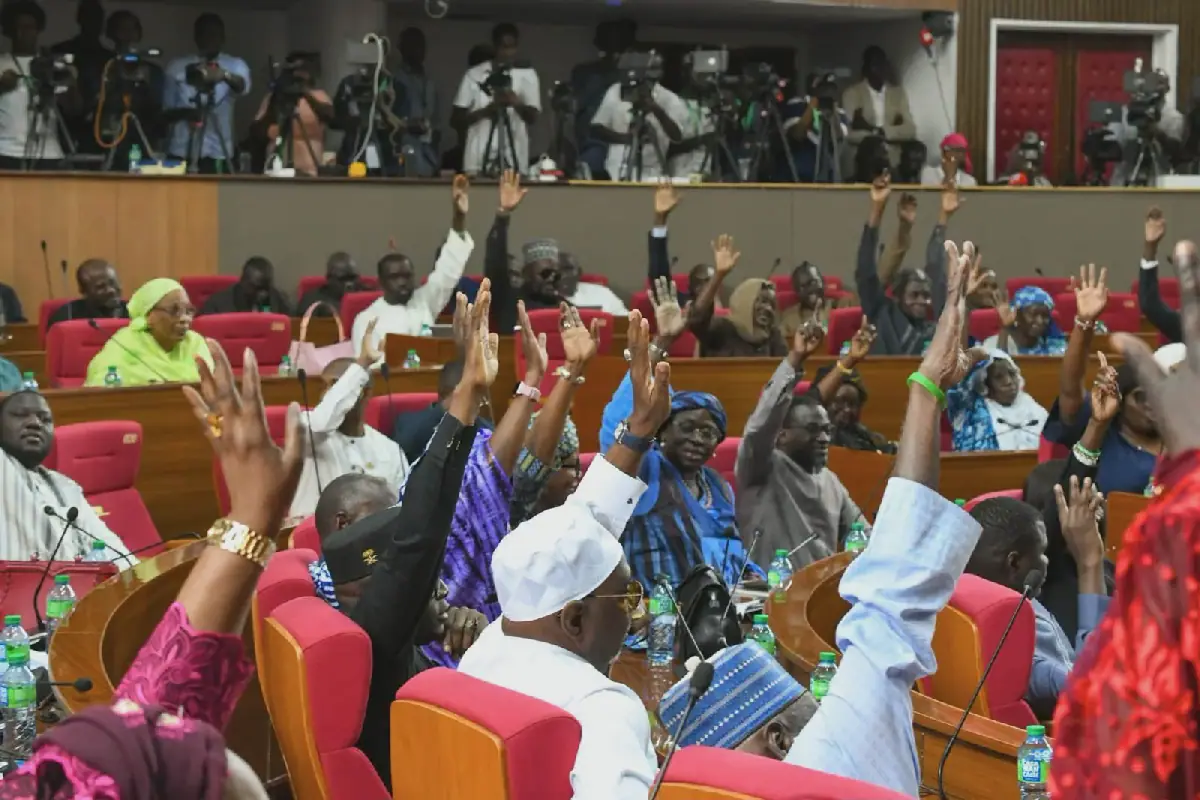
The Senegalese National Assembly adopted a resolution on November 25, 2026, regarding the presidential decree that enacted the 2026 rectification budget law, despite the law being rejected by parliament on November 3. The resolution aims to address the institutional and legal implications of this decision and the responsibilities associated with its implementation. The move is seen as a bid to defend the authority of the parliamentary vote.
The rejected rectification budget law was put into effect through decree No. 2026-2416 on November 19, 2026. The National Assembly's resolution was presented by Mohamed Ayib Salim Daffé, a member of the PASTEF Les Patriotes parliamentary group. Daffé argued that the decree raises questions about the respect for the constitutional prerogatives of the National Assembly, particularly regarding the interpretation of certain constitutional and organic law articles.
The articles in question are articles 68, paragraphs 3 and 5, of the Constitution, and article 57, paragraph 2, of the organic law on finance laws. Daffé contested the use of a subsidiary procedure meant to ensure state budget continuity to re-enact a law that was explicitly rejected by parliamentarians. This situation has sparked a debate that goes beyond the execution of the rectification budget, touching on the scope of parliamentary vote and the balance between institutions.
The plenary debates also focused on the practical consequences of this situation, including the responsibilities that may fall on government authorities, spending officers, and public accountants in charge of budget execution. The issue also concerns the technical and financial partners of Senegal, particularly the International Monetary Fund (IMF). The adopted text aims to draw attention to the implications of this situation for the various actors involved in public finance management.
Through this resolution, the National Assembly seeks to reaffirm the authority of its decisions, the principle of separation of powers, and its constitutional prerogatives in budgetary matters. The debate around the 2026 rectification budget law takes on an institutional dimension, beyond its financial content. This move is seen as a critical step in defending the role and authority of the parliament in Senegal's governance.
The resolution has been introduced amid concerns about the potential impact on the country's budgetary processes and the relationship between the executive and legislative branches. The National Assembly's move is expected to have significant implications for the implementation of the rectification budget law and the broader governance landscape in Senegal.
Key stakeholders, including government officials, parliamentarians, and representatives from the IMF, are closely watching the developments. The situation underscores the complexities of governance and the importance of clear communication and collaboration between different branches of government. The National Assembly's resolution is a significant step in addressing these challenges and ensuring the effective functioning of Senegal's democratic institutions.
Key points
- The Senegalese National Assembly adopted a resolution to defend its vote on the 2026 rectification budget law.