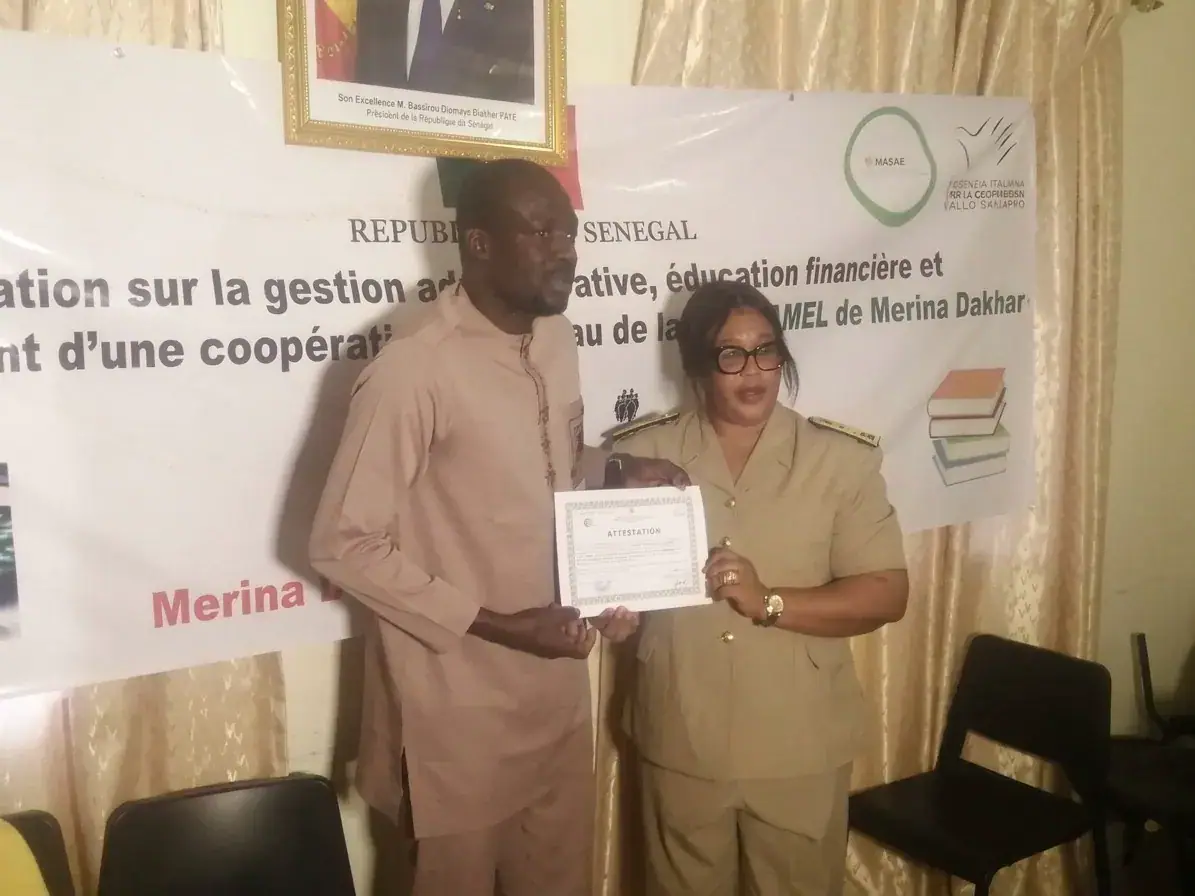
The Senegalese government is turning to agriculture as a solution to the country's rapid population growth, youth unemployment, and irregular emigration. The national agricultural investment program, PAPSEN, has taken a step in this direction by training 30 leaders of agricultural groups in Mérina Dakhar. The five-day training program focused on financial education, cooperative management, and administrative skills.
The training program is part of PAPSEN's efforts to develop the agricultural sector, which employs over 60% of Senegal's active population but remains underproductive and heavily dependent on climate conditions. According to Kalidou Kane, coordinator of PAPSEN's central zone, the program aims to strengthen the capacity of agricultural actors in the Mérina Dakhar area.
The CAC Damel cooperative, which comprises 1913 members, including 1366 women and 547 men, with 80% of its members being young people, is one of the groups that benefited from the training. The cooperative currently has 31 farms operating, despite some difficulties that are being addressed. PAPSEN's program includes actions such as water management, capacity building for beneficiaries, and agricultural mechanization.
The program has already achieved some successes, including the establishment of two agricultural cooperatives, each covering 100 hectares, in two communes. A tractor is expected to be delivered to the communes soon. PAPSEN is working in collaboration with technical partners, including the Regional Rural Development Division, the Rural Equipment Modeling Directorate, and the ANIDA.
The training program is aligned with Senegal's national transformation agenda, which prioritizes agricultural cooperatives as a means of achieving food self-sufficiency by 2050. The program's coordinator, Kalidou Kane, reaffirmed PAPSEN's commitment to building a resilient and sustainable agricultural sector, in line with the new policies of the Ministry of Agriculture, Food Sovereignty, and Livestock.
The beneficiaries of the training program, including Ablaye Gaye, Nogaye Fall, and Moustapha Bassirou Guèye, president of the Mérina Dakhar CAC, have called for the continuation of PAPSEN beyond its scheduled end date of December 31, 2026. The mayor of Mérina Dakhar, Mamour Syll, and the sub-prefect, Maimouna Baldé, have also expressed their support for the program's continuation.
The sub-prefect, Maimouna Baldé, has promised to report to her superiors on the need to continue PAPSEN in Mérina Dakhar and other villages. She emphasized the importance of the program in the region's socio-economic development. PAPSEN's efforts have been hailed as a step in the right direction for Senegal's agricultural sector, which is critical to the country's economic growth and food security.
Key points
- PAPSEN's training program aims to strengthen the capacity of agricultural actors in Senegal.
- The program includes actions such as water management, capacity building, and agricultural mechanization.
- The program is aligned with Senegal's national transformation agenda, prioritizing agricultural cooperatives for food self-sufficiency.