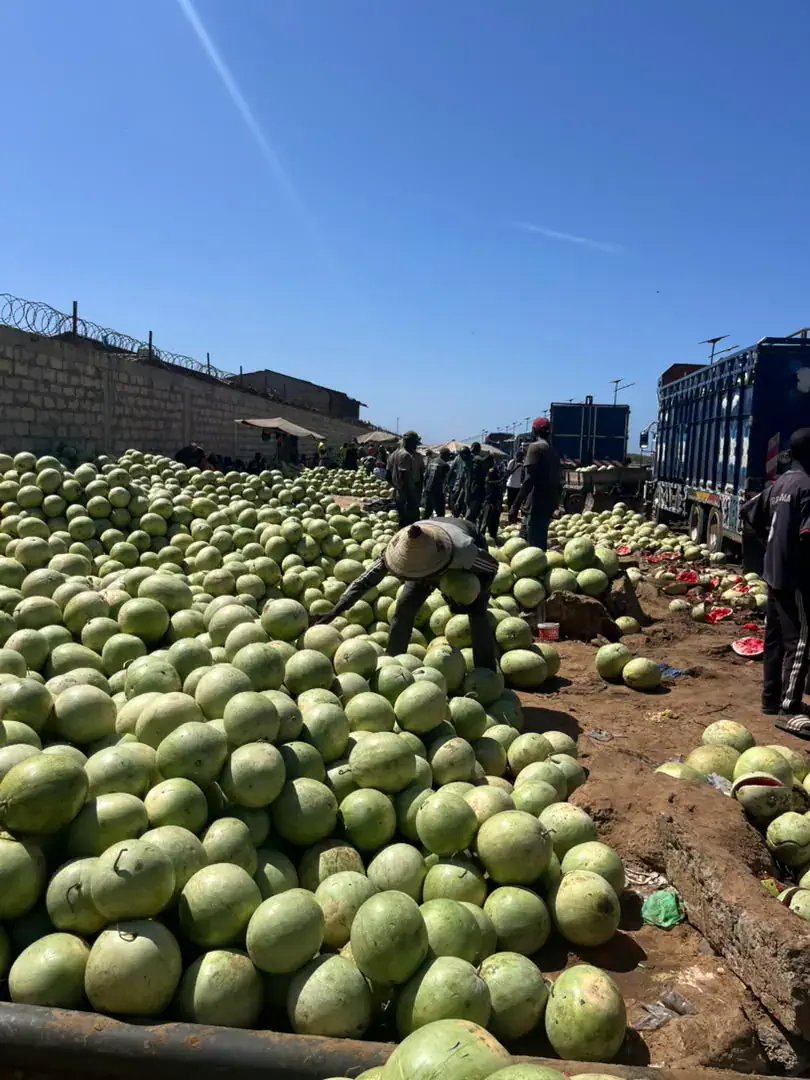
The Gadaye market in Dakar, Senegal, is bustling with activity as the peak watermelon season reaches its climax. Located at a major roundabout, the market has become a hub for watermelon sales, with trucks, tricycles, and carts transporting the fruit from various regions, including Saloum, Walo, Tamba, and even Gambia. The intense logistics chain is in full swing, with wholesalers, retailers, and consumers all benefiting from the abundant supply of watermelons.
The market scene is chaotic, with the scorching sun beating down on the vendors and their wares. A gentle breeze from the nearby sea provides some relief from the heat, but the cacophony of horns and constant chatter from the vendors creates a lively atmosphere. Watermelons are stacked haphazardly, with some fruits split open, revealing their red flesh. Vendors are busy unloading the fruits from trucks, while others are haggling over prices.
Abdou Ndoye, a wholesaler, says his watermelons come from various regions, including Saloum, Walo, Tamba, and Gambia. He sells his watermelons in bulk, with prices fixed per unit. Ndoye reveals that his customers come from all over Dakar, including Grand Yoff, Keur Massar, and Parcelles. Despite the lucrative business, Ndoye laments the lack of infrastructure, including shaded storage facilities, which can lead to spoilage and losses.
Yoro Séne, a retailer, buys watermelons from the market and resells them to consumers. He offers various types of watermelons, including panal, Dutch, and Danish varieties. Séne claims to have developed an expertise in identifying ripe watermelons, which he can do with a simple glance. To prevent spoilage, Séne uses tarps and parasols to shield the fruits from the sun.
Another popular way to sell watermelons is by cutting them into smaller portions, making them more affordable for low-income consumers. For just 100 FCFA, customers can buy a slice of watermelon, providing a refreshing treat for those who cannot afford a whole fruit. Mme Dramé, a vendor, says this business is not very lucrative, but it allows her to make some extra money and provide a service to her customers.
The watermelon market at Gadaye is a significant contributor to the informal economy, supporting a wide range of actors, from transporters to retailers. The market also has a system for disposing of unsold or spoiled watermelons, which are often used as animal feed. Fallou, a tricycle driver, says he transports watermelons from the market to retailers and consumers, with prices varying depending on the destination.
As the peak season winds down, the Gadaye market will likely return to its normal rhythm, but for now, it remains a hub of economic activity, supporting the livelihoods of many vendors and consumers alike. The market's ability to adapt to changing supply and demand, as well as its resourcefulness in utilizing by-products, makes it a remarkable example of Senegal's vibrant informal economy.
Key points
- The Gadaye market is a significant hub for watermelon sales in Dakar, Senegal, with a complex logistics chain supporting various actors.
Reporting sources
- Au cœur de l’effervescence de Gadaye · Le Soleil