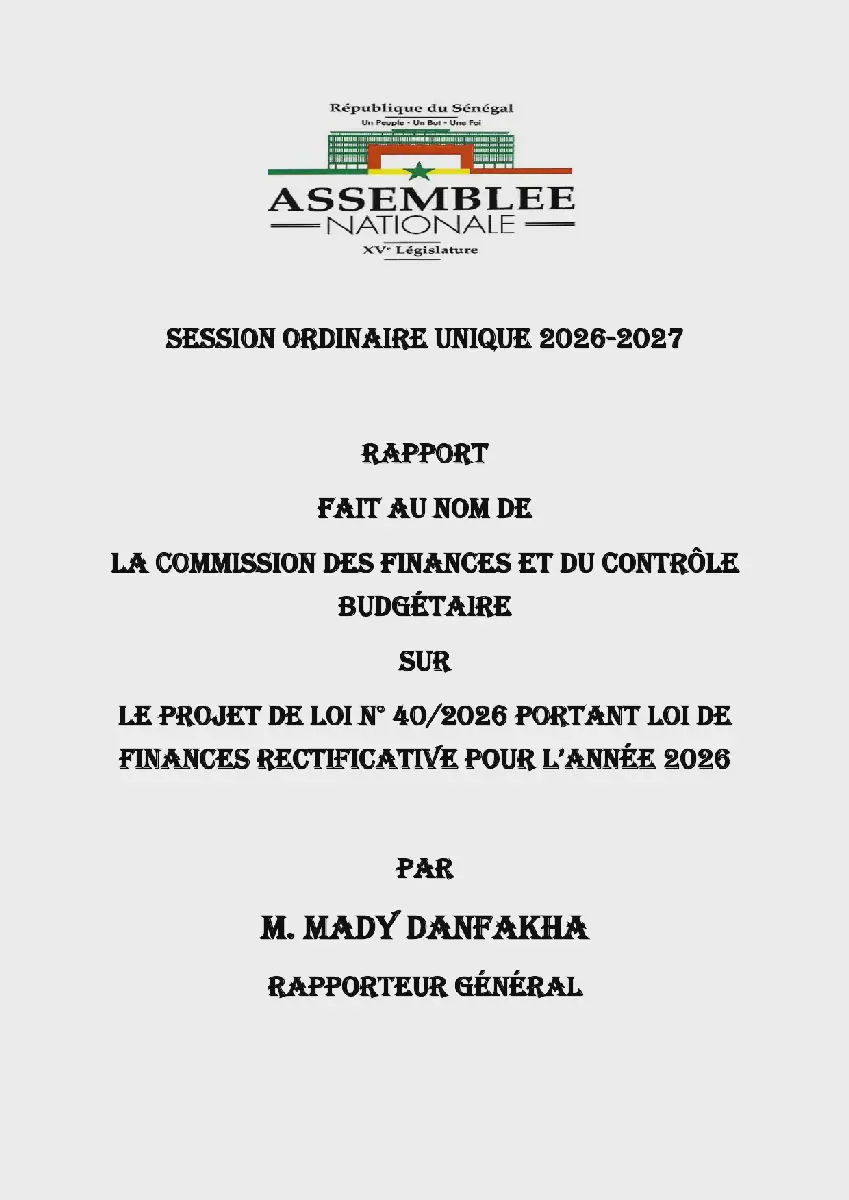
The Commission des Finances et du Contrôle budgétaire of Senegal's National Assembly has examined the draft law n° 40/2026 on the 2026 rectified finance law. The project was presented by the Government on October 20 and 23, 2026. It outlines adjustments to the budget, including reduced revenues, increased energy subsidies, and revised public investments. These changes are due to external and internal economic shocks. The Commission rejected the project after debates, pending clarifications on debt, social investments, and funding transparency.
The 2026 rectified finance law projects a reduction in total revenues from 6,188.8 to 5,848.7 billion FCFA, a 5.5% decrease. At the same time, expenditures are expected to increase from 7,433.9 to 7,583.9 billion FCFA, a 2% rise. This will widen the deficit to 1,735.2 billion FCFA, equivalent to 7.6% of the GDP. Energy subsidies have been increased to 790.3 billion FCFA, a 540.3 billion FCFA rise, to mitigate the impact of rising oil prices.
The revenues from the Economic and Social Recovery Plan (PRES) have been revised to 311.5 billion FCFA, down from the initial 762.9 billion FCFA projection. This reduction has led to the freezing of investment projects. The Commission introduced five tax measures, including a solidarity economic contribution on the turnover of operators and a minimum lump-sum tax set at 0.5% of turnover.
Social spending is maintained at 2,276 billion FCFA, accounting for 30% of total expenditures. There is an increase in health credits by 28.8 billion FCFA and a doubling of family social security grants from 35 to 70 billion FCFA. The Commission's report details the economic context and the government's justifications for the budget adjustments.
The draft law was examined during sessions on October 20 and 23, 2026. It aims to adapt the 2026 budget to the new economic situation marked by external and internal shocks. The Commission's discussions highlighted the need for greater transparency in debt management and social investments.
The finance commission's report is part of a series of budget and economic analysis documents presented to the National Assembly. Other recent reports include those on the country's health situation in prisons and the modification of the biometric identity card.
The Commission's review of the 2026 budget revision highlights the challenges facing Senegal's economy. The country must balance its budget while addressing social needs and responding to economic shocks. The government's proposals and the commission's recommendations will be crucial in shaping the country's economic policy.
Key points
- The 2026 rectified finance law projects a 5.5% decrease in total revenues.
- Energy subsidies have been increased to 790.3 billion FCFA.
- Social spending is maintained at 2,276 billion FCFA.