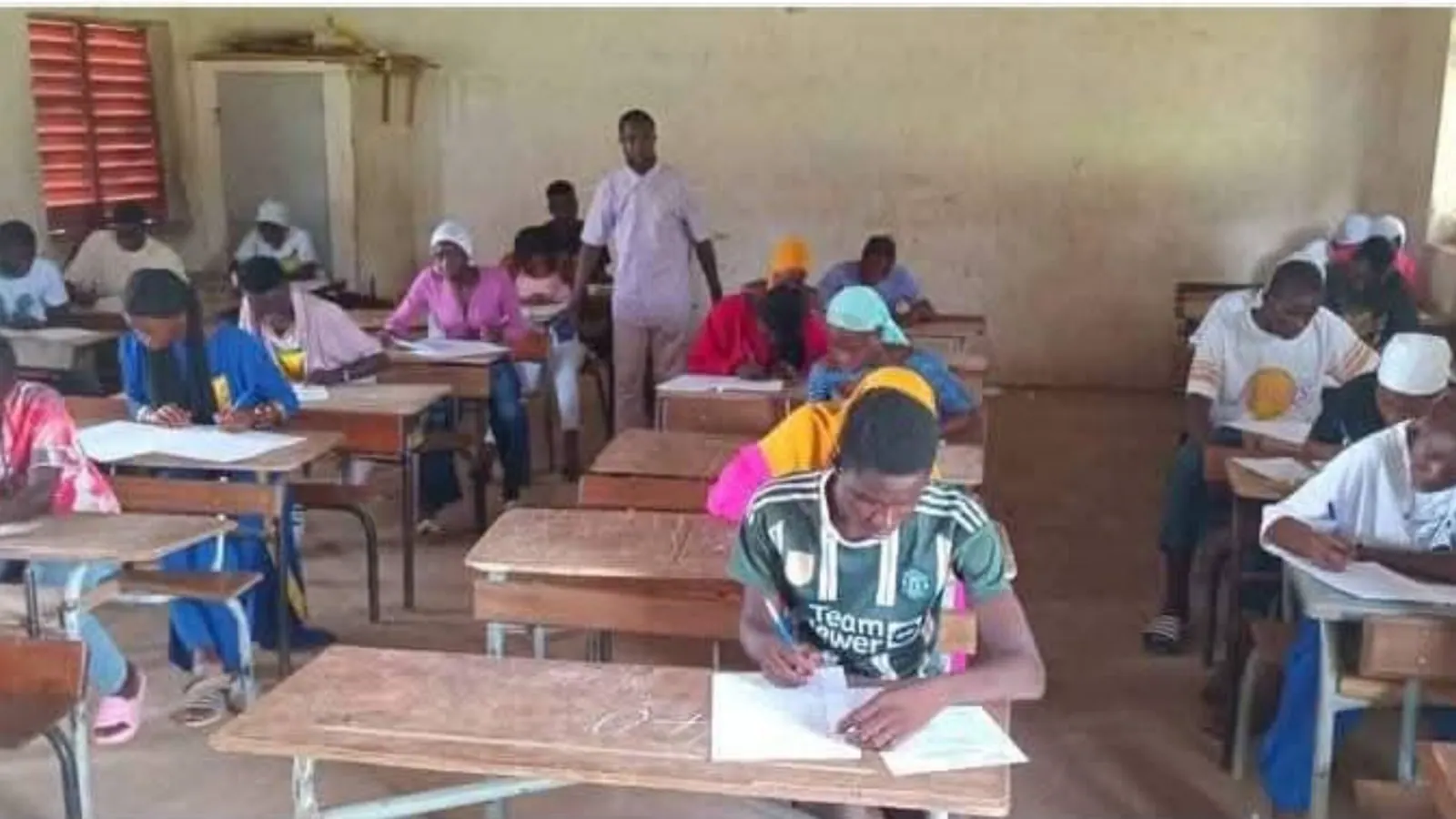
Senegal's Minister of National Education, Moustapha Mamba Guirassy, has announced significant improvements in the country's education sector, citing a notable increase in academic performance and infrastructure development. According to Guirassy, the pass rate for the Certificate of Elementary Education (CFEE) has risen from 65% in 2024 to 94% in 2026. Similarly, the pass rate for the Brevet de fin d'études moyennes (BFEM) has increased from 70% to 79%, while the baccalaureate pass rate has improved from around 48% to 54%.
The minister attributes these improvements to the government's investment in education infrastructure. A total of 1,305 classrooms, 14 colleges, and three general education high schools have been built. Additionally, six science blocks, administrative and hygiene blocks, and 44,000 linear meters of perimeter walls have been constructed. Several projects are currently underway, including the construction of 46 high schools, 46 middle schools, and 46 elementary schools. The government plans to build an additional 2,500 classrooms to increase the capacity of educational institutions.
Guirassy emphasizes that the development of education infrastructure is crucial to supporting pedagogical transformations in the sector. He notes that the government's efforts are focused on improving the quality of education and increasing access to scientific and technical subjects. The minister has announced plans to introduce a national competition, MASTEC, which will focus on mathematics, science, technology, and numeracy for students from primary to high school.
The government's policy of encouraging more students to pursue scientific subjects has raised concerns among some school administrators and parents. They argue that students' choices should be based on their abilities and preferences. However, Guirassy insists that the policy is not simply an administrative instruction, but rather a well-considered approach that has been developed in consultation with experts and specialists.
The minister highlights the importance of teacher training in the development of the education sector. He notes that the government is working to strengthen the recruitment of specialized teachers and improve their training. The introduction of mathematics evaluation in teacher training at the Centre régional de formation des maîtres (CREM) is part of this effort.
Guirassy also emphasizes the role of national languages in learning and education. He argues that students learn more effectively when they can use their mother tongue and plans to introduce national languages into elementary education and middle school, particularly in mathematics and science.
The minister's efforts to improve the education sector have been complemented by other initiatives, including the development of ethnosciences and ethnomathematics, which aim to link scientific knowledge to local cultural and linguistic realities. The government plans to strengthen psychological support for students to help them identify their abilities and build their educational pathways from an early age.
Key points
- The Senegalese government has invested heavily in education infrastructure, resulting in significant improvements in academic performance.
- The government is promoting a greater emphasis on scientific subjects, with a focus on mathematics, science, technology, and numeracy.
- The use of national languages in education is being explored as a way to improve learning outcomes.