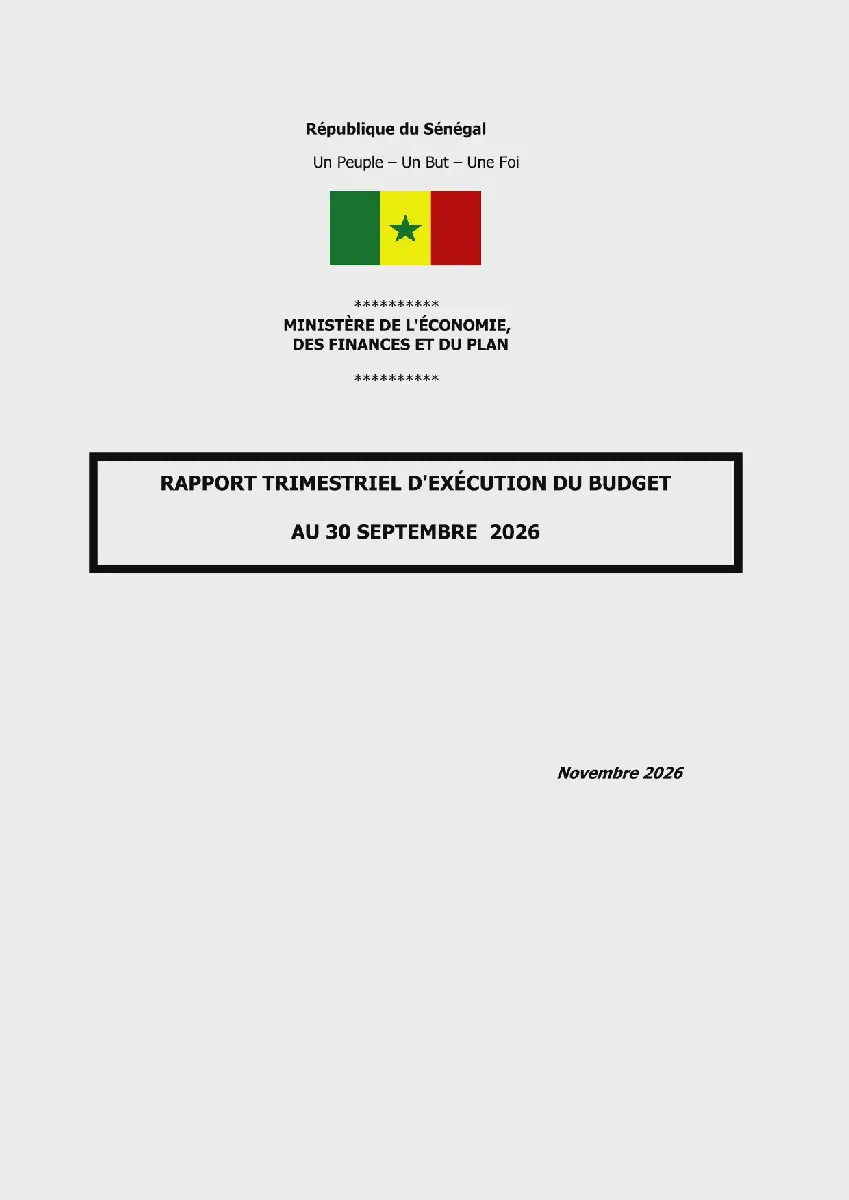
The Senegalese Ministry of Economy, Finance and Planning has released the Rapport trimestriel d'exécution du budget (RTEB) for the third quarter of 2026, providing an analysis of the country's budget execution as of September 30, 2026. The report highlights a growth rate of 6.1% in the second quarter of 2026 and an inflation rate of 1.0%. The RTEB report covers revenues, expenditures, deficit, and the situation of public organisms.
According to the RTEB report, revenues reached 3,785.2 billion FCFA, representing 63.8% of the annual target. Fiscal revenues stood at 3,484.3 billion FCFA, with a shortfall of 127.1 billion FCFA due to the Plan de redressement économique et social (PRES). Non-fiscal revenues, on the other hand, reached 255.0 billion FCFA, exceeding the quarterly target by 16.1%, driven by revenues from the domain and hydrocarbons.
The report also reveals that total expenditures amounted to 4,370.7 billion FCFA, representing 60.8% of the opened credits. Ordinary expenditures accounted for 75.4% of the opened credits, with 1,142.5 billion FCFA allocated to personnel and 1,049.9 billion FCFA for current transfers. Capital expenditures were executed at 38.1%, with 641.3 billion FCFA from internal resources and 426.7 billion FCFA from external resources.
The budget deficit stood at 585.5 billion FCFA, representing 47.0% of the annual target. The Fonds national de Retraite (FNR) recorded an excess of 28.2 billion FCFA, with 161,213 contributors and 77,850 pensioners. The report provides a comprehensive analysis of the Senegalese state's budgetary situation, highlighting key trends and areas of focus.
The RTEB report is a critical tool for monitoring the country's budget execution and provides valuable insights for policymakers, stakeholders, and the general public. The report's findings will inform the government's budgetary decisions and policy interventions aimed at promoting economic growth and stability.
The Senegalese government's efforts to promote transparency and accountability in budget execution are reflected in the timely release of the RTEB report. The report's availability will enable stakeholders to assess the country's progress toward achieving its economic development goals and identify areas for improvement.
The Ministry of Economy, Finance and Planning is expected to build on the findings of the RTEB report to inform its policy interventions and budgetary decisions. The report's recommendations will likely focus on enhancing revenue mobilization, optimizing expenditures, and promoting economic growth and stability in Senegal.
Key points
- The Senegalese economy recorded a growth rate of 6.1% in the second quarter of 2026.
- The inflation rate remained contained at 1.0% as of September 30, 2026.
- The budget deficit stood at 585.5 billion FCFA, representing 47.0% of the annual target.