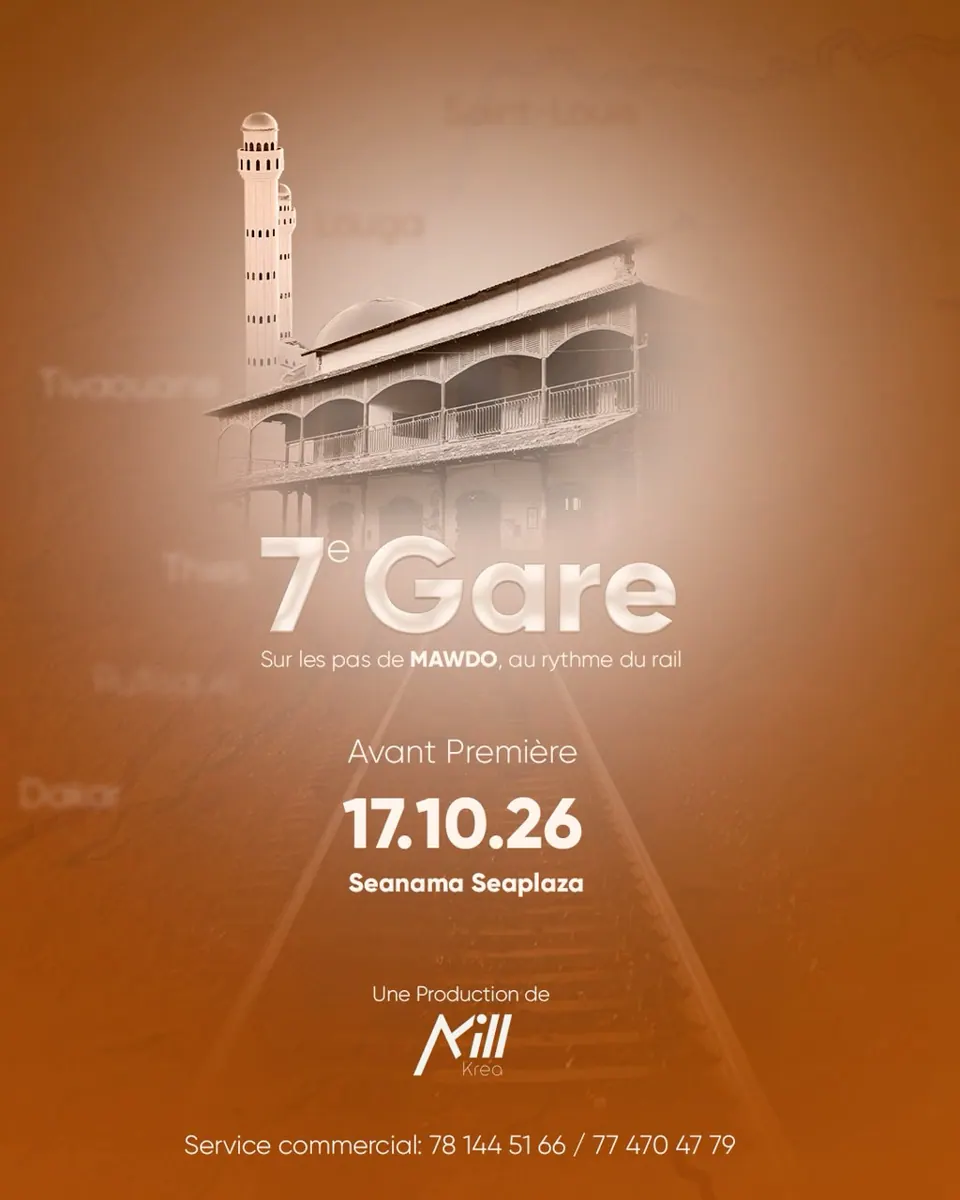
The documentary "7e Gare," directed by Abdoul Aziz Al Hussein Diop and Maniang Diagne, explores the impact of Seydil Hadj Malick Sy on various cities in Senegal, including Saint-Louis, Louga, Thiès, Rufisque, and Dakar. The film highlights the role of the train in disseminating ideas, knowledge, and spiritual heritage. By tracing the railway line, the documentary reveals the connections between these cities and Tivaouane, where Seydil Hadj Malick Sy had a significant influence.
The documentary is inspired by a spiritual exchange between Seydil Hadj Malick Sy and Mame Khalifa, which has been passed down through collective memory. The film features interviews, archives, testimonies, portraits, and prospective views to examine the special bonds between Seydil Hadj Malick Sy and the cities visited. In Saint-Louis, the documentary focuses on Sy's stay in the former political and intellectual capital of French West Africa, his intellectual and religious influence, and his relationships with notable figures.
The project aims to revive the memory of Seydil Hadj Malick Sy's legacy and its impact on the territories and people. By combining the memories of the railway, religious heritage, and national narrative, "7e Gare" seeks to demonstrate how a religious and intellectual heritage has been inscribed in the territories and memories. The documentary's approach highlights the significance of each railway station as a starting point for reflection on the circulation of knowledge, faith, and civilizations in Senegal.
The documentary is not only a look back at the past but also an exploration of its relevance to contemporary Senegal and its future. A panel discussion on the revival and future of Senegal's railways will follow the screening, bringing together institutional and railway actors, representatives of religious families, academics, historians, and development stakeholders. This event aims to spark a dialogue on the future of Senegal's railways and their role in shaping the country's development.
The documentary "7e Gare" is set to premiere on October 17, 2026, with a 52-minute screening followed by a 60-75 minute public exchange. The project is an initiative of the Senegalese newspaper Le Soleil, which seeks to use cinema as a space for memory and dialogue. By rediscovering the traces of Seydil Hadj Malick Sy in the territories traversed by the train, the documentary aims to open a discussion on the future of Senegal's railways.
The film's journey takes viewers through various cities, including Saint-Louis, Louga, Thiès, Dakar, and Rufisque, which were all connected by the railway line. These cities are not just points on a map but spaces of transmission, radiation, and influence. The documentary highlights the role of the Zawiya as a space for knowledge and spiritual education, particularly in Saint-Louis.
The documentary "7e Gare" offers a unique perspective on Senegal's history, culture, and development. By exploring the legacy of Seydil Hadj Malick Sy and the impact of the railway on Senegalese society, the film provides a nuanced understanding of the country's past, present, and future. The project is a significant contribution to Senegal's cultural and intellectual landscape, and its premiere is eagerly anticipated.
Key points
- The documentary "7e Gare" explores the social, spiritual, and intellectual influence of Seydil Hadj Malick Sy on various cities in Senegal.
- The film highlights the role of the train in disseminating ideas, knowledge, and spiritual heritage in Senegal.
- A panel discussion on the revival and future of Senegal's railways will follow the screening of the documentary.