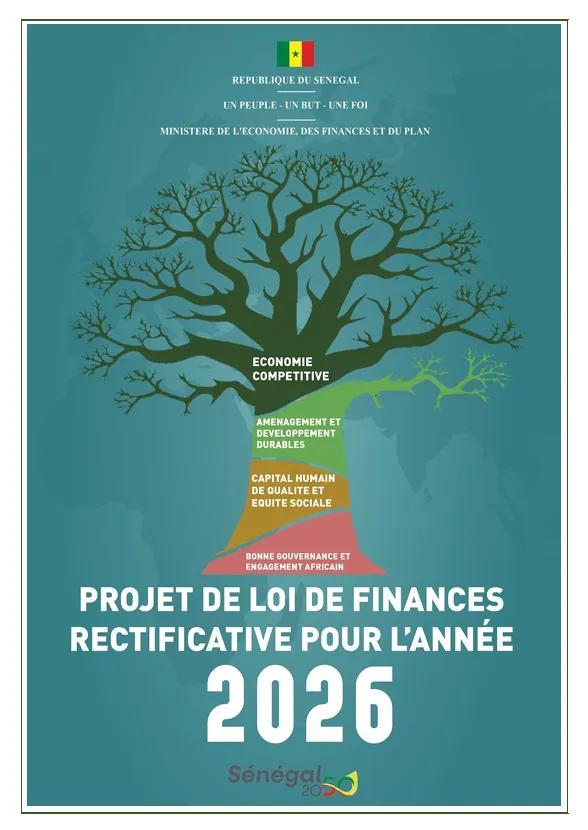
The Senegalese government, led by the Ministry of Economy, Finance, and Planning, has introduced a revised 2026 budget law to address the country's economic challenges. The revised budget aims to respond to a difficult international context marked by geopolitical tensions and an energy crisis. The new budget forecasts a higher deficit and adjusts revenue and expenditure projections. This move is crucial in ensuring the country's economic stability.
The revised budget law projects a deficit of 7.6% of GDP, up from the initial 5.4% forecast. This increase is primarily due to higher energy subsidies, which have risen to 790.3 billion FCFA, a significant jump from the initial 250 billion FCFA. Additionally, the government has lowered its revenue projections to 5,848.7 billion FCFA, a decrease of 340.1 billion FCFA. These adjustments reflect the government's efforts to respond to the current economic challenges.
The revised budget allocates more resources to priority sectors, with total expenditures reaching 7,583.9 billion FCFA, an increase of 150 billion FCFA. The government aims to optimize revenue collection through fiscal adjustments and focus on social sectors. These measures are designed to mitigate the impact of the economic crisis on the country's citizens. The budget revisions also reflect a reorientation of public spending to address pressing social needs.
Key aspects of the revised budget include a higher deficit of 1,735.2 billion FCFA, equivalent to 7.6% of GDP. General budget revenues are estimated at 5,516.7 billion FCFA, a decrease of 415.5 billion FCFA compared to the initial budget. General budget expenditures, however, have increased to 7,251.9 billion FCFA, a rise of 74.6 billion FCFA. These changes demonstrate the government's efforts to rebalance its budget in response to economic pressures.
The revised budget also introduces several significant measures. A new contribution from electronic money operators has been established, with a progressive rate of 8% to 10%. Additionally, temporary fiscal and customs advantages have been reinstated for social housing programs. Furthermore, the budget allows for the integration of 300 billion FCFA of verified non-financial debt into the state's accounts. These measures aim to enhance revenue collection and support social initiatives.
The government's budget revisions also reflect a decline in certain revenue streams. Fiscal revenues have decreased by 453.3 billion FCFA, primarily due to lower expected revenues from the Economic and Social Recovery Plan (PRES). In contrast, current transfers have increased by 535 billion FCFA. The budget also shows a decrease in capital expenditures financed by internal resources, which have dropped by 315.7 billion FCFA.
The revised budget law demonstrates the Senegalese government's proactive approach to addressing the country's economic challenges. With a focus on optimizing revenue collection, prioritizing social sectors, and adjusting to the current economic context, the government aims to maintain economic stability and promote sustainable growth. The revised budget will be crucial in guiding the country's economic policy in the coming year.
Key points
- The revised 2026 budget law forecasts a higher deficit of 7.6% of GDP.
- Energy subsidies have increased to 790.3 billion FCFA.
- The budget revises revenue projections downward to 5,848.7 billion FCFA.