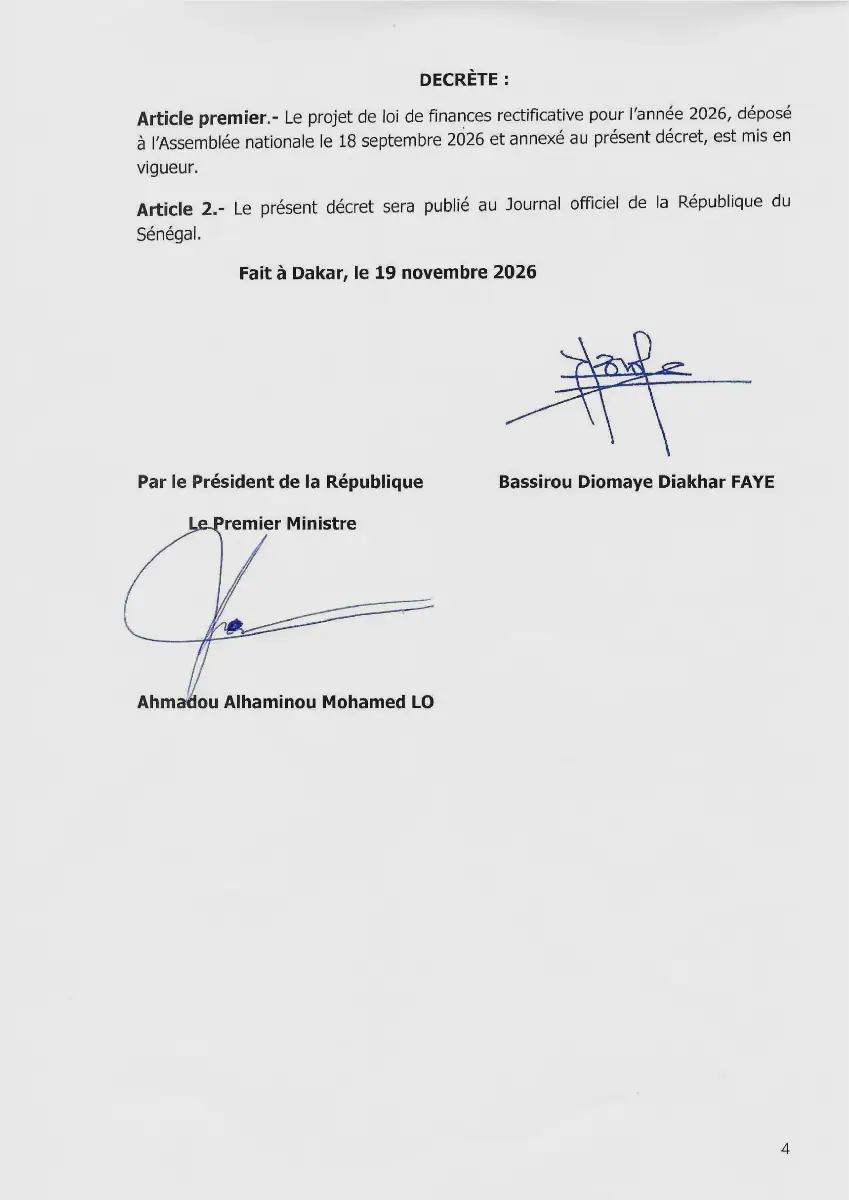
On November 19, 2026, Senegalese President Bassirou Diomaye Diakhar Faye signed Decree No. 2026-2416, putting into effect the 2026 rectified budget law. This move follows the National Assembly's rejection of the budget proposal. According to the Constitution, specifically Article 68, paragraph 5, the President can enact the budget by decree if the Assembly fails to vote on it within the allotted timeframe. The decree is based on Articles 42 and 68 of the Constitution and the Organic Law No. 2020-07 related to budget laws.
The rectified budget law was previously rejected by the National Assembly during committee and plenary sessions on October 30 and November 3, 2026. The Assembly had 60 days to vote on the proposal, as stipulated in Article 68, paragraph 3 of the Constitution. However, the government's proposed amendments were not adopted by the deputies. As a result, President Faye exercised his constitutional authority to enact the budget by decree.
The decree includes the rectified budget law as an annex. The budget adjustments aim to reflect changes in the country's financial situation and priorities for 2026. The government's decision to push forward with the rectified budget despite the Assembly's rejection underscores the importance of maintaining fiscal stability and continuity in public spending.
This development is part of a series of presidential decrees issued in recent months. Other notable decrees include No. 2026-1176, establishing the General Directorate of Financing and Debt within the Ministry of Economy, Finance, and Planning, and No. 2026-1133, reorganizing state services and oversight of public establishments and companies.
The implementation of the rectified budget is expected to have implications for various sectors, including education and extractive industries. For instance, Decree No. 2026-1112, issued in May 2026, introduced significant changes to the education system, including the creation of a certificate of completion of elementary education and the abolition of the entrance exam to the sixth grade.
The President's use of decree powers to enact the budget reflects the complex interplay between the executive and legislative branches in Senegal. The Constitution provides for such measures to ensure governance continuity, but it also underscores the challenges in achieving consensus between the government and the National Assembly.
The enactment of the rectified budget law is a critical step in maintaining Senegal's economic stability and ensuring the continuity of public services. As the country navigates its fiscal challenges, the government's ability to implement its budget priorities will be closely watched by stakeholders, both domestically and internationally.
Key points
- President Bassirou Diomaye Diakhar Faye enacted the 2026 rectified budget into law via Decree No. 2026-2416 on November 19, 2026.