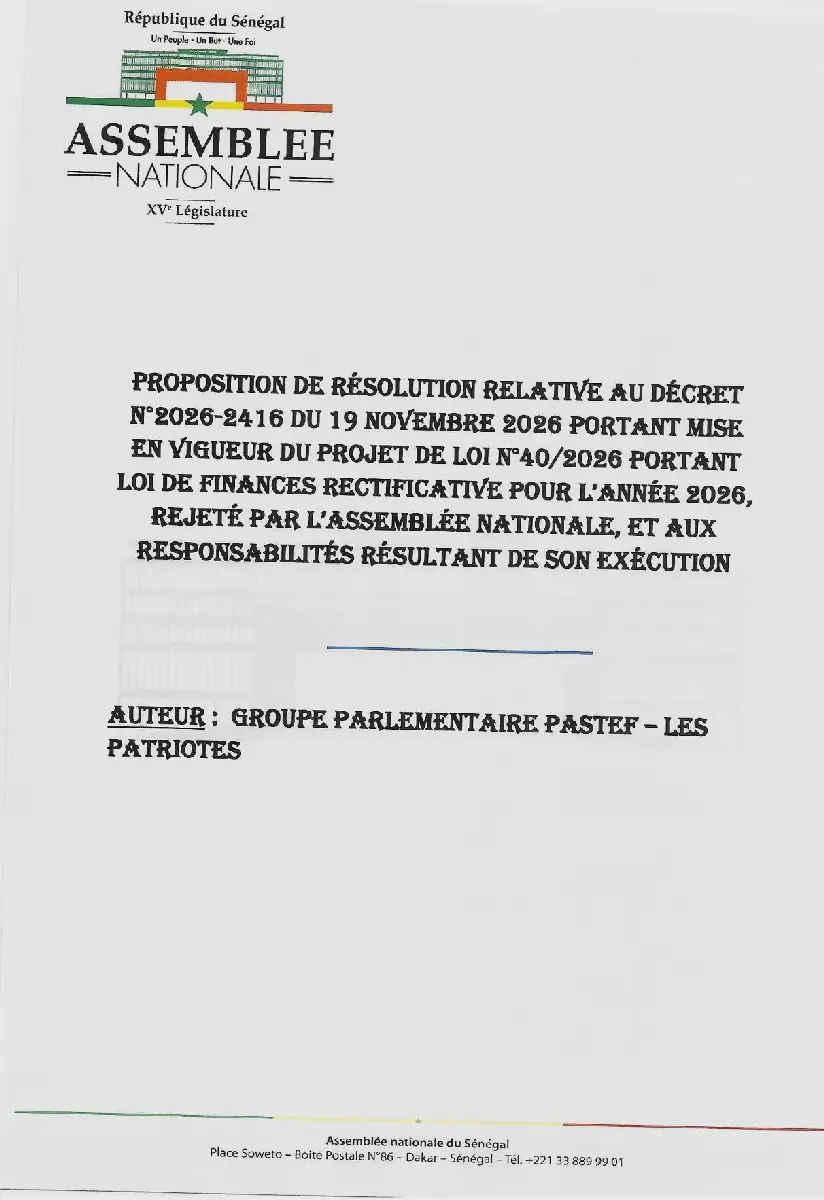
The PASTEF – Les Patriotes parliamentary group in Senegal's National Assembly has filed a resolution contesting a presidential decree that implemented a rejected 2026 supplementary budget. The decree, number 2026-2416, was signed by the President on November 19, 2026, and put into effect law number 40/2026, which was rejected by the National Assembly on November 3, 2026. The parliamentary group claims the decree is illegal.
The rejected law, number 40/2026, was voted down using a preliminary question based on article 83 of the National Assembly's internal regulations, with 126 votes. Despite this, the President invoked articles 68 and 57 of the Constitution and the organic law on finance laws to justify the decree. This move has sparked controversy, with the parliamentary group demanding its withdrawal.
The resolution filed by PASTEF – Les Patriotes emphasizes that public officials, including budget administrators, tax and customs authorities, must verify the legality of operations based on the contested decree. Failure to do so may result in them being held accountable. The resolution also stresses that no loans or financial commitments can be made without explicit parliamentary authorization, as per the public accounting regulations.
The parliamentary group argues that the decree undermines the role of the National Assembly in approving the budget and financial laws. They claim that the President's actions are an overreach of executive power and an attempt to bypass legislative oversight. The resolution has been submitted to the National Assembly for consideration.
The 2026 supplementary budget was intended to make adjustments to the country's financial plan for the year. However, its rejection by the National Assembly indicates a significant disagreement between the legislative and executive branches. The controversy surrounding the presidential decree has raised concerns about the separation of powers and the rule of law in Senegal.
The National Assembly's examination of the 2026 budget settlement will include a thorough review of operations executed under the contested decree. This process is expected to shed light on the implications of the presidential decree and the actions taken by public officials in implementing it. The Assembly's scrutiny will help determine the decree's impact on the country's finances and governance.
The dispute between the PASTEF – Les Patriotes parliamentary group and the President's administration highlights the ongoing tensions between the executive and legislative branches in Senegal. The outcome of this controversy will have significant implications for the country's governance, accountability, and the balance of power between the branches of government.
Key points
- The Senegalese National Assembly rejected the 2026 supplementary budget with 126 votes.
- The presidential decree was signed on November 19, 2026, and put into effect a rejected law.
- Public officials must verify the legality of operations based on the contested decree to avoid accountability.