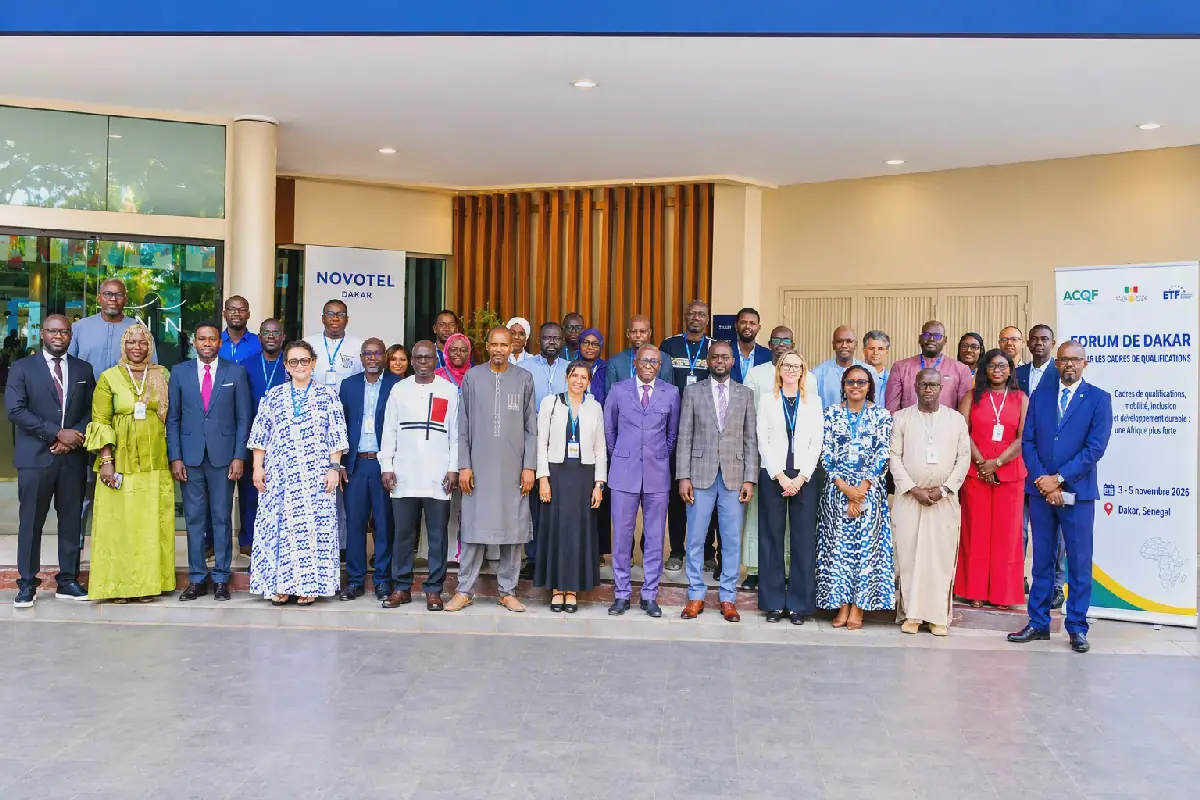
The Senegalese government has taken a significant step towards establishing a National Qualifications Framework (CNQ-SN) with the holding of the Dakar Forum on Qualifications Frameworks from November 3-4, 2026. The forum brought together representatives from public institutions, ministries, higher education and vocational training establishments, technical and financial partners, and experts from several African countries. The event also saw the participation of nearly 100 representatives from over a dozen West African countries via distance learning.
The forum marked the official launch of the inter-ministerial committee tasked with establishing the CNQ-SN, created by an inter-ministerial decree in April 2026. The committee is chaired by Professor Massamba Diouf, Executive Secretary of the National Authority for Quality Assurance in Higher Education (ANAQ-Sup). In his welcome address, Professor Diouf emphasized the importance of an inclusive approach that brings together various ministerial departments, training institutions, employers, and worker organizations.
During the forum, participants reviewed the conceptual note developed by the Technical Working Group under the aegis of ANAQ-Sup and engaged in discussions on the foundations of the future framework. The framework's legal device, governance, economic model, and financing mechanisms were among the topics examined. The event also provided an opportunity for participants to learn about the instruments developed by the African Qualifications Framework (ACQF), including peer learning, referencing national frameworks, and the African Qualifications and Certifications Platform.
The Dakar Forum aims to strengthen West African countries' adherence to the continental dynamic led by the African Union through the ACQF. By establishing common references between national qualifications systems, the initiative seeks to facilitate the recognition of diplomas and certifications, promote academic mobility of students and researchers, and enhance professional mobility of workers across the continent. Participants also had the chance to learn from countries that have already established national qualifications frameworks, such as South Africa, Kenya, and Zambia.
The experiences of countries with established national qualifications frameworks will enrich the discussions and promote the sharing of best practices with countries engaged in this dynamic. The forum's outcomes are expected to provide guidance for the next steps in establishing the CNQ-SN. The conclusions will be consolidated in a report that will serve as a roadmap for the inter-ministerial commission.
At the end of the forum, participants are expected to have a shared understanding of the evolution of qualifications frameworks in West Africa, identify the needs of different countries, and develop strategic orientations for the continuation of the CNQ-SN establishment process. The report will be used to inform the inter-ministerial commission's future actions.
The establishment of the CNQ-SN is seen as a crucial step towards enhancing the recognition of qualifications and mobility in Africa. The framework is expected to contribute to the development of a more cohesive and harmonized qualifications system in Senegal and across West Africa.
Key points
- The Senegalese government has launched a forum to establish a National Qualifications Framework (CNQ-SN) to enhance the recognition of qualifications and mobility in Africa.
- The framework aims to facilitate the recognition of diplomas and certifications, promote academic mobility of students and researchers, and enhance professional mobility of workers across the continent.
- The forum brought together representatives from public institutions, ministries, higher education and vocational training establishments, technical and financial partners, and experts from several African countries.