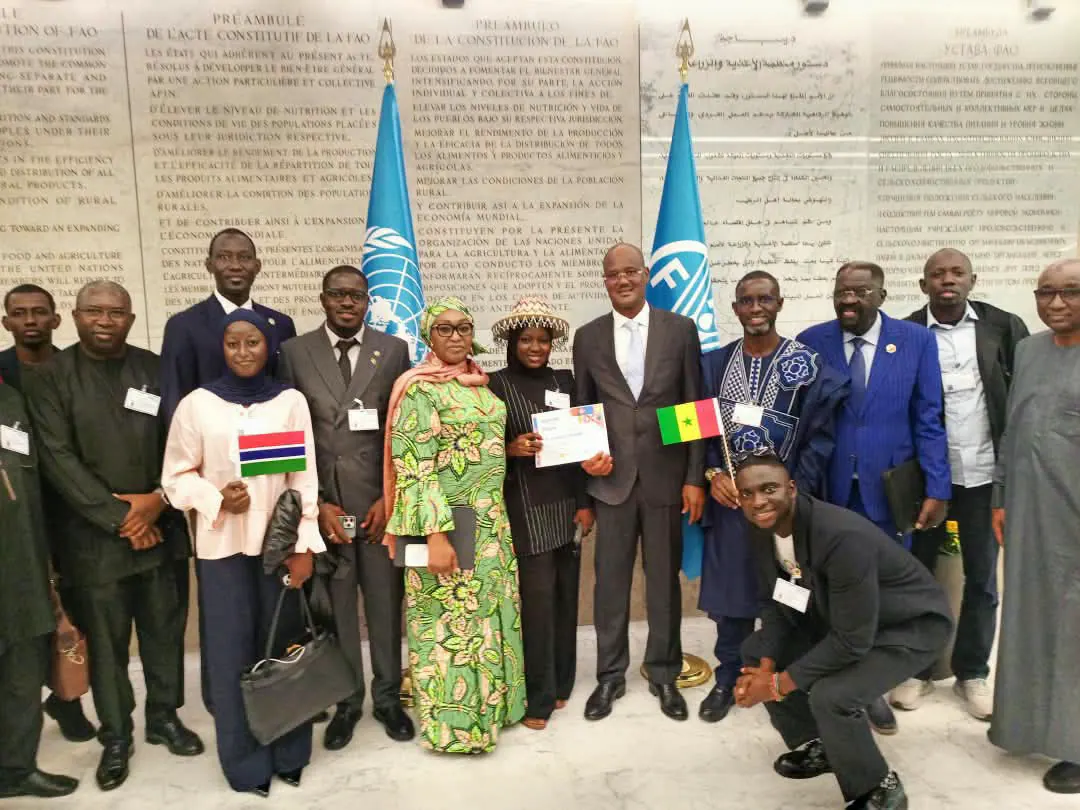
The Senegalese delegation, led by Minister of Agriculture, Food Sovereignty, and Livestock Cheikhou Oumar Ba, participated in the World Food Forum 2026 at the Food and Agriculture Organization (FAO) headquarters in Rome, Italy, from October 8-16. The forum aimed to transform agri-food systems, and Senegal highlighted the crucial role of youth in achieving food sovereignty. Representing President Bassirou Diomaye Diakhar Faye, Minister Ba emphasized that youth participation is essential to realizing national ambitions in food sovereignty.
Senegal's approach focuses on empowering young people to contribute to food production by providing access to training, financing, land, and technology. The government aims to promote mechanisms that facilitate their integration into agricultural value chains. With over 60% of Senegal's population being young, Minister Ba stressed that harnessing their potential is vital for transforming the sector. Beyond traditional farming, opportunities exist in food processing, mechanization, trade, digitalization, and e-commerce, offering prospects for entrepreneurship and job creation in rural areas.
The Conseil national de concertation et de coopération des ruraux (CNCR), a rural cooperation and consultation council, also participated in the forum through its coordinator, Elhadji Thierno Cissé. The CNCR advocates for the strategic role of family farms in Senegal's food sovereignty and calls for sustainable investments in agrosylvopastoral and fisheries sectors. The organization emphasizes the importance of dialogue between the state and rural movements, highlighting the need to support local innovations and facilitate access to productive resources for young people and women.
The World Food Forum 2026 brought together governments, farmers' organizations, youth, scientists, and investors to address food security and sustainable transformation of agri-food systems. Discussions highlighted the contributions of youth, science, innovation, and investment in building resilient food systems. The mobilization around creating 100 national youth chapters demonstrates the effort to engage young people in decision-making spaces. Several prominent figures, including Ecuador's Vice President Verónica Abad Pinto and the First Lady of Gabon, emphasized the conditions necessary for youth empowerment.
For Senegal, the forum provided an opportunity to promote a vision of agriculture as a sector of innovation, entrepreneurship, and wealth creation, rather than a default activity. The country's delegation underscored the importance of translating discussions into concrete actions, ensuring effective access to productive resources, and mobilizing financing to support youth. The Senegalese government's message is clear: youth must be central to agricultural transformation, which is crucial for employment, territorial development, and food sovereignty.
The CNCR's participation in the forum aimed to bring the concerns of rural producers to the forefront of international discussions on the future of food systems. The organization advocates for an approach that considers territorial realities, values peasant know-how, and supports local innovations. This approach seeks to balance productivity improvement, resilience of family farms, and economic inclusion of rural populations.
As the World Food Forum 2026 comes to a close, the focus shifts to implementing the orientations discussed in Rome into tangible actions on the ground. For Senegal, achieving food sovereignty relies on increased youth involvement and sustained support for family farms. The forum has contributed to strengthening partnerships and mobilizing investments to enhance national production capacities.
Key points
- Senegal emphasizes youth participation in agriculture to achieve food sovereignty.
- The government aims to provide young people with access to training, financing, land, and technology to contribute to food production.
- The Conseil national de concertation et de coopération des ruraux advocates for the strategic role of family farms in Senegal's food sovereignty.